

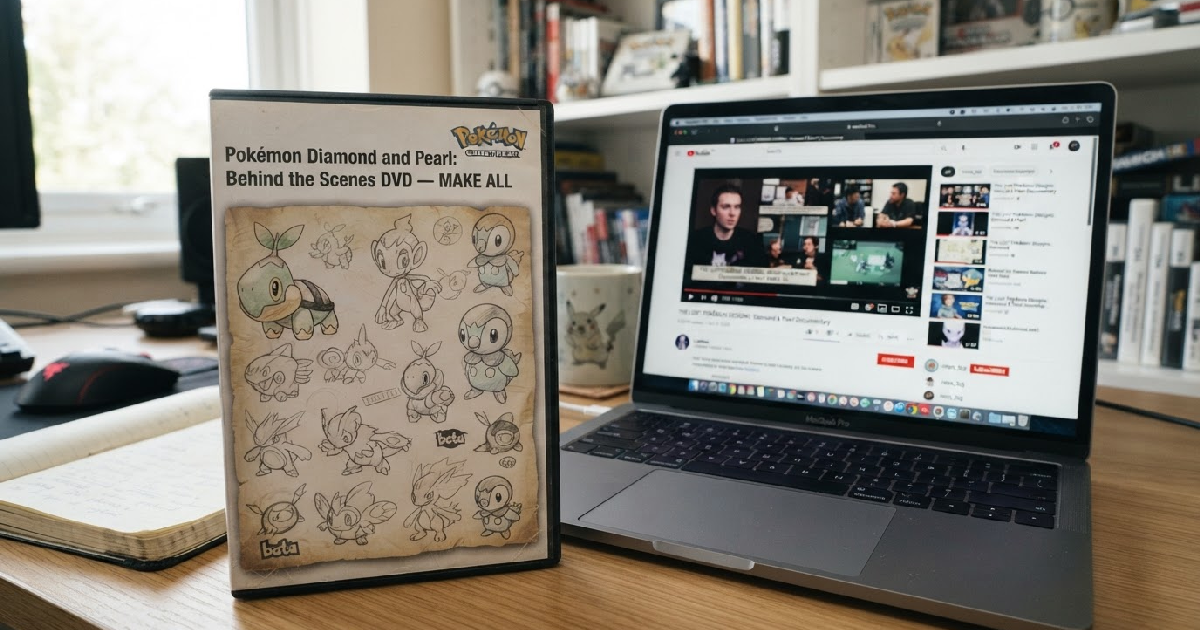
Game Freaks internal Pokémon Diamond and Pearl film shows lost designs
An internal Game Freak documentary, Pokémon Diamond and Pearl: Behind the Scenes DVD — MAKE ALL, publicly surfaced online on July 22, 2026. This 43-minute film, chronicling the two-year development of the Nintendo DS games, provides an unprecedented look at the creation of the Sinnoh region, revealing over 100 previously unseen early and scrapped Pokémon designs.
Pokémon collector Neos (neos_tcg) acquired a rare copy of the DVD, which a team of archivists led by Pokémon historian Lewtwo then meticulously preserved and uploaded to YouTube and the Internet Archive. The documentary offers fans a deep dive into the creative process behind one of the franchise’s most beloved generations.
Decades-old game development documentary reveals lost Pokémon designs
For nearly two decades, this glimpse into the foundational stages of Pokémon Diamond and Pearl remained largely hidden, known only through a brief mention by director Junichi Masuda in a 2007 blog post. Game Freak originally produced the documentary for its staff, who viewed it during a Pokémon Day celebration, with DVD copies allegedly distributed afterwards.
The surfacing of this rare game development documentary represents a significant moment for video game archivists. It highlights the dedicated efforts of individuals like Neos, who managed to secure a copy from a trusted source in June 2026 after a brief appearance on the Japanese marketplace Mercari earlier in February, selling for ¥82,000 (around $500 USD).
The meticulous effort to preserve gaming history
Lewtwo, a prominent Pokémon YouTuber and archivist, spearheaded the preservation effort once Neos obtained the DVD. His team conducted a rapid process to dump and publicize the documentary’s contents. This dedication ensures that a vital piece of gaming history, previously at risk of being lost forever, is now accessible to a global audience.
The documentary itself is in Japanese, but a full English translation is currently planned, which will unlock its secrets to even more fans. This type of archival work is crucial for understanding the evolution of game design and the creative challenges faced by developers.
Unveiling early Sinnoh region Pokémon concepts
One of the most compelling aspects of the Pokémon Diamond and Pearl: Behind the Scenes DVD MAKE ALL is its extensive showcase of unreleased Pokémon designs. This includes hundreds of concepts that never made it into the final Nintendo DS titles, offering a fascinating alternate history of the Sinnoh region’s inhabitants.
Some of the most striking revelations involve early iterations of familiar creatures. Turtwig, for instance, began life as a Grass-type armadillo, a stark contrast to its final tortoise-like appearance. Infernape was envisioned as a heavy-set baboon with a flaming tail, and Piplup once sported a literal crown and a full parka, suggesting much grander initial concepts for the beloved starters.
Starter evolution and forgotten creatures
Beyond the starters, the documentary details many more evolutionary lines and standalone Pokémon that were drastically altered or abandoned. Purugly, for example, resembled Glameow far more closely, though it kept its distinctive coiled tail. Even legendary Pokémon like Dialga had an early design described simply as “kinda freaky.”
The film also shows a proto-Bidoof and an early concept for a yellow regional form of Gastrodon, highlighting how much iteration goes into character design. But perhaps even more intriguing are the completely scrapped Pokémon.
- A two-stage sandcastle family.
- A saber-toothed jackal with icicle fangs.
- A constantly sleeping bear named Yasuraguma.
- A rocky Pokémon resembling a train.
- A planned Lapras pre-evolution.
- A Delibird evolution.
- A Stantler pre-evolution.
- A possible third evolution for Swellow.
- What appear to be baby forms shared by Plusle and Minun.
These dozens of unreleased creatures offer a tantalizing glimpse into the vast design space Game Freak explored. It’s a reminder that for every Pokémon that makes it into a game, many more are left on the drawing board.
Behind the scenes: two years of creation
The Game Freak documentary doesn’t just focus on creature designs; it chronicles the entire two-year development period of Pokémon Diamond and Pearl, which began on January 20, 2004. This expansive look covers everything from the initial mythological concepts for the Sinnoh region to the significant challenges of creating the series’ first environments using 3D graphics.
Viewers can see early gameplay footage, showing how the game evolved visually and mechanically. There are also videos detailing the creation of the popular Underground feature and the implementation of online functionalities, which were groundbreaking for the Nintendo DS era. The documentary even includes original Japanese commercials for the games, including their first reveal trailer and one advertising Wi-Fi functionality.
From 3D graphics to underground exploration
Beyond the main feature, the DVD includes additional content that further illuminates the development process. The disc features a music video titled “決起!” which is a compilation of images taken by Game Freak staff during the series’ 10th anniversary. This visual montage is set to “Dive For You” by J-pop band Boom Boom Satellites.
The physical disc itself is adorned with a “PROJECT CAMEX” logo, a clever parody of the Twentieth Century Fox emblem featuring Blastoise. It also depicts early designs of Dialga and Palkia that are not shown within the documentary footage. A large, foldable insert accompanying the DVD offers a detailed chronology of Diamond and Pearl‘s development, juxtaposed with real-world events and other game releases.
This insert contains early settei, or design sheets, for Pokémon like Budew, Buneary, and Chatot. An early map of Sinnoh and 3D models for the player’s house and Pokémon Center are also included.
Concept sketches for The Underground by Shigeru Ohmori are present, alongside a monitor displaying Nintendo/GAME FREAK’s IS-NITRO-DEBUGGER tool and a Nintendo DS development kit, offering a granular view of the technical side of game creation.
This kind of raw, unfiltered access to early development tools and assets is invaluable for understanding how these iconic games came to be, much like the process behind post-launch updates in current titles.
The broader significance of game preservation
The release of this Game Freak documentary underscores the critical role of video game archiving and preservation in safeguarding cultural history. Organizations like the Video Game History Foundation and dedicated individuals such as Lewtwo and Neos are actively working against the clock to ensure that the rich heritage of interactive entertainment isn’t lost to time.
Internal documents, early builds, and behind-the-scenes footage like this DVD are often the only remaining windows into the challenges, creative decisions, and technological constraints that shaped beloved titles. Without these efforts, countless stories of innovation, scrapped ideas, and developer ingenuity would simply vanish.
A new window into Game Freak’s creative process
This long-awaited surfacing of the Pokemon Diamond and Pearl: Behind the Scenes DVD MAKE ALL provides more than just trivia for fans; it offers genuine insight into Game Freak’s iterative design philosophy. The sheer volume of discarded and redesigned Pokémon demonstrates the rigorous selection process involved in crafting new creatures for the franchise.
It also highlights the consistent artistic direction from key figures like Ken Sugimori, who, alongside Satoshi Tajiri and Junichi Masuda, has guided the visual identity of Pokémon since its inception. Even as the company has grown, with 207 employees as of March 2024 and headquarters in Tokyo’s Kanda Square, their core approach to extensive ideation and refinement remains evident.
The documentary serves as a powerful reminder of the deep well of creativity and hard work that underpins every Pokémon generation. For fans, it’s a treasure trove of what-ifs and fascinating glimpses into a world that almost was, solidifying its place as a crucial artifact in Pokémon lore.