

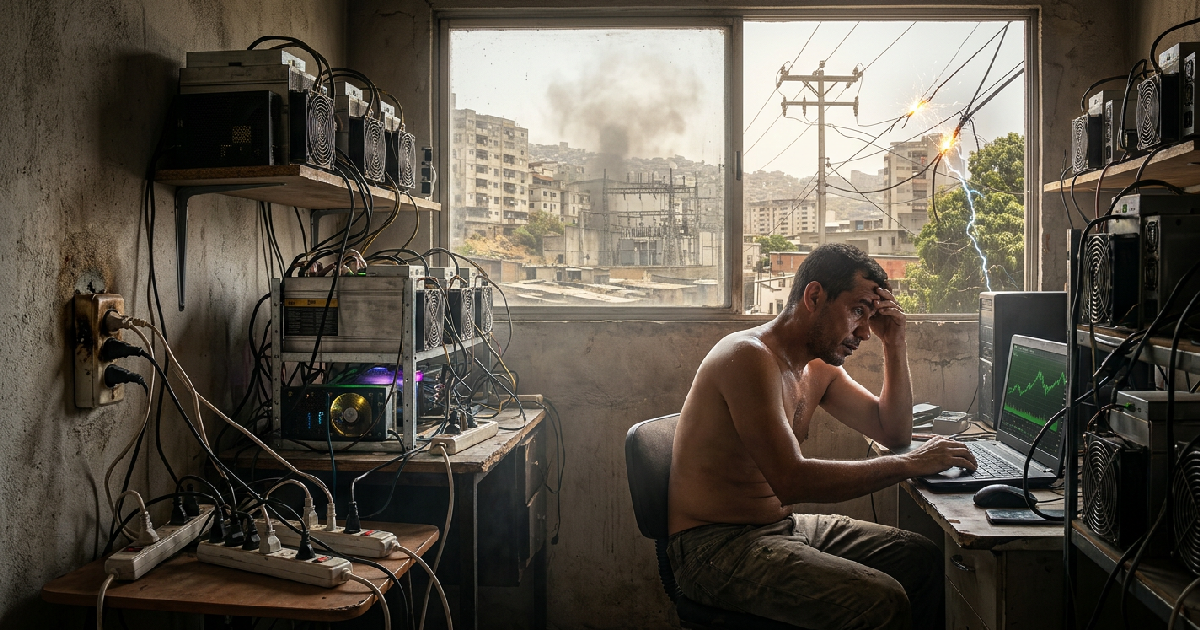
Venezuela Imposes National Crypto Mining Ban Amid Power Crisis
The government of Venezuela has reportedly enforced a nationwide prohibition on cryptocurrency mining as electricity demand reaches critical levels. President Nicolás Maduro and the Ministry of Electric Power confirmed the activation of a rigorous supervision plan designed to identify and penalize unauthorized mining operations that drain the national power grid. This regulatory crackdown follows reports of extreme heat waves and claims of continued economic activity that have pushed the country’s aging energy infrastructure to its breaking point.
The move represents a significant shift for a nation that once promoted digital assets as a tool for economic survival. Officials stated that the absolute ban is a necessary measure to ensure the stability of public electricity services, which have been plagued by instability. Many regions have reported recurring outages, reminiscent of previous systemic blackouts that paralyzed the nation for days. By targeting the energy-intensive nature of proof-of-work mining, the administration hopes to reclaim enough capacity to maintain civilian and industrial power supply.
Authorities have already begun a door-to-door inspection initiative in areas suspected of hosting large-scale mining operations. While the government previously regulated mining through specialized agencies, this new directive suggests that even licensed operators must now disconnect their hardware indefinitely. The crackdown aims to prevent what the ministry describes as the “voracious consumption” of electricity that often leads to localized transformer failures and wider grid collapses.
Energy Crisis Forces Regulatory Pivot in Caracas
The current energy deficit is not a new phenomenon for Venezuela, but the intensity of the recent heat wave has accelerated the need for drastic intervention. Since the historic national blackout of 2019, the grid has struggled with maintenance issues and a lack of investment. As temperatures rise, the increased use of air conditioning coupled with industrial growth has created demand levels that the current infrastructure cannot reliably meet.
This situation mirrors broader trends where the market faces significant headwinds in 2026 due to regulatory and infrastructure limitations. Venezuela’s decision to cut off miners is a survival tactic. For miners, the low cost of electricity was the primary draw, but that advantage has now vanished under the weight of the state’s mandate to protect the domestic supply at any cost.
Impact on Local Crypto Users and Infrastructure
Venezuela has maintained high rates of crypto adoption in Latin America, largely driven by residents seeking alternatives to the devalued sovereign bolivar. However, the ban creates a sharp divide between casual users holding assets on exchanges and those operating the hardware that secures blockchains. The disconnection of these rigs will likely reduce the local hashrate significantly, forcing many small business owners who invested in hardware to seek and operate in neighboring jurisdictions or shutter their operations entirely.
The government’s supervision plan is not just about power, but also about control. By making crypto mining a punishable offense, the state can monitor high-consumption residential and commercial areas more closely. This approach contrasts sharply with other nations that are trying to integrate digital assets, such as how David Sacks has joined PCAST as asset drives grow in the United States. While some countries are looking toward expansion, Venezuela is looking toward preservation.
Global Market Context and Regional Precedents
Venezuela is not the first nation to take such a hardline stance against mining during a power crisis. Countries like Kazakhstan and Iran have previously implemented temporary or permanent bans when winter heating or summer cooling needs exceeded supply. The Venezuelan ban signifies a broader pattern where emerging markets must prioritize basic utilities over the technological windfall of the blockchain industry.
This volatility in the mining sector contributes to the overall market sentiment, particularly when liquidity declines significantly across major assets. When a nation that was once a mining hub pulls the plug, it removes a layer of geographic decentralization. Though the global Bitcoin hashrate typically absorbs these shocks quickly, the humanitarian and economic impact on the ground in Venezuela is far more persistent.
Predicting the Duration of the Mining Halt
There is currently no official timeline for when—or if—the mining rigs will be allowed to reconnect. Government rhetoric suggests that as long as the high demand on the power grid persists or grows, the ban will remain in place. The Ministry of Electric Power has indicated that the focus will remain on upgrading primary substations before any high-consumption industrial activities are reconsidered.
Miners are now facing a difficult choice: sell their equipment at a loss or wait out a power crisis that has already lasted years. Given the strictness of the current supervision plan and the threat of legal punishment, the era of sanctioned mining in Venezuela appears to have reached a definitive, if perhaps temporary, end.