

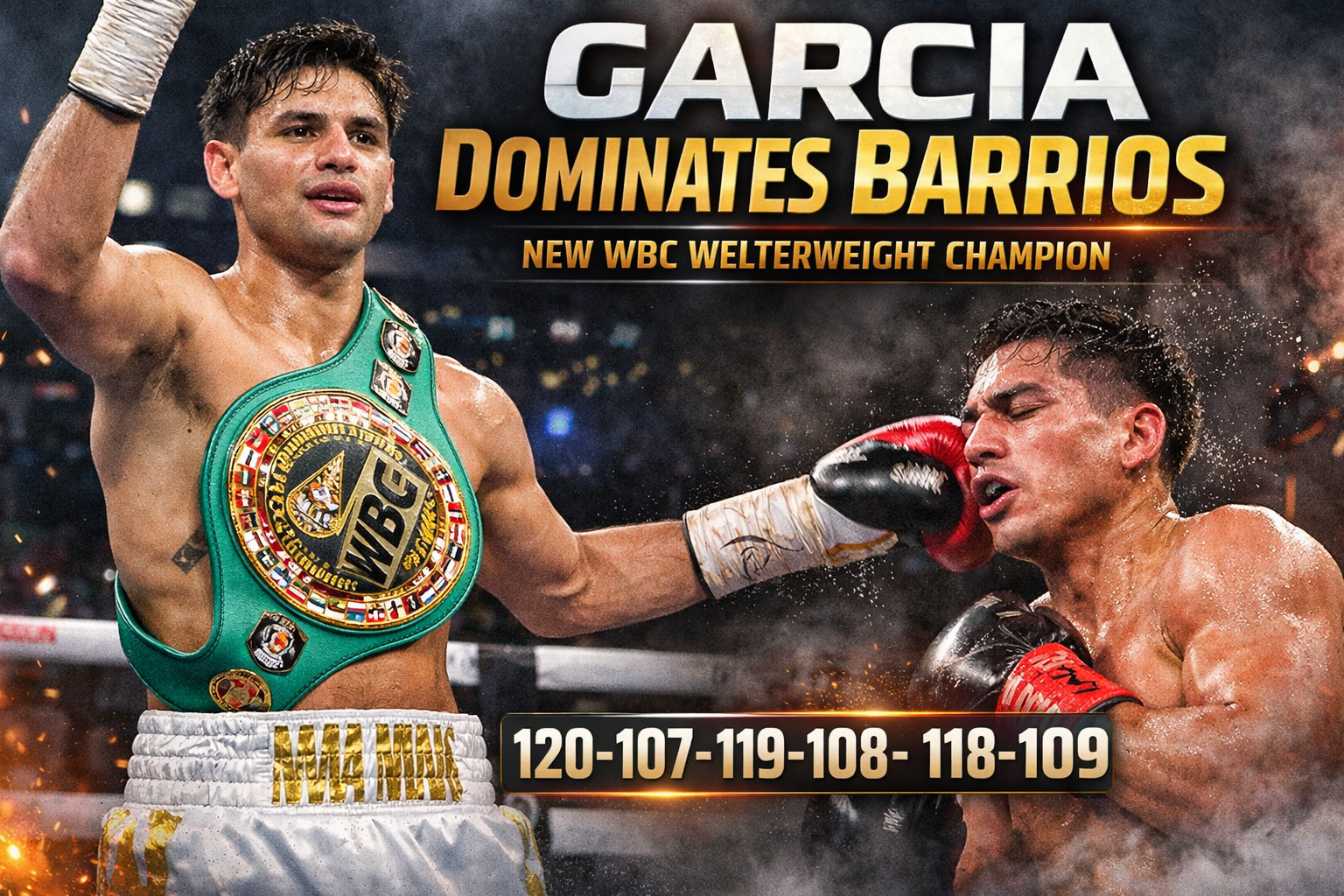
Ryan Garcia Controls Every Dimension to Capture WBC Welterweight Title
Ryan Garcia didn’t rely on drama to win a championship — he relied on structure.
Inside Las Vegas’ T-Mobile Arena, Garcia delivered a performance that unfolded with calculated precision rather than emotional momentum. Against Mario Barrios, a fighter known for resilience and pressure, Garcia turned the contest into a strategic exercise in distance, timing, and disciplined execution.
By the time the final bell sounded, the outcome felt less like a competitive result and more like the logical conclusion of twelve rounds of tactical control.
The Fight’s Direction Was Established Almost Immediately
The early knockdown did more than score points — it forced the entire fight into Garcia’s preferred framework.
Barrios, typically effective when building forward pressure, suddenly had to chase the fight. That shift played directly into Garcia’s strengths. He maintained spacing, repositioned constantly, and forced Barrios to reset before meaningful exchanges could develop.
Rather than allowing rhythm to form, Garcia broke the flow of the fight repeatedly. Each attempted surge from Barrios became fragmented — start, stop, reset, repeat.
Momentum never had the chance to exist.
Precision Replaced Volume as the Primary Weapon
Garcia’s dominance was not built on overwhelming activity. It was built on selective accuracy.
He engaged when angles were clean.
He exited when counters threatened.
He targeted the body to erode mobility.
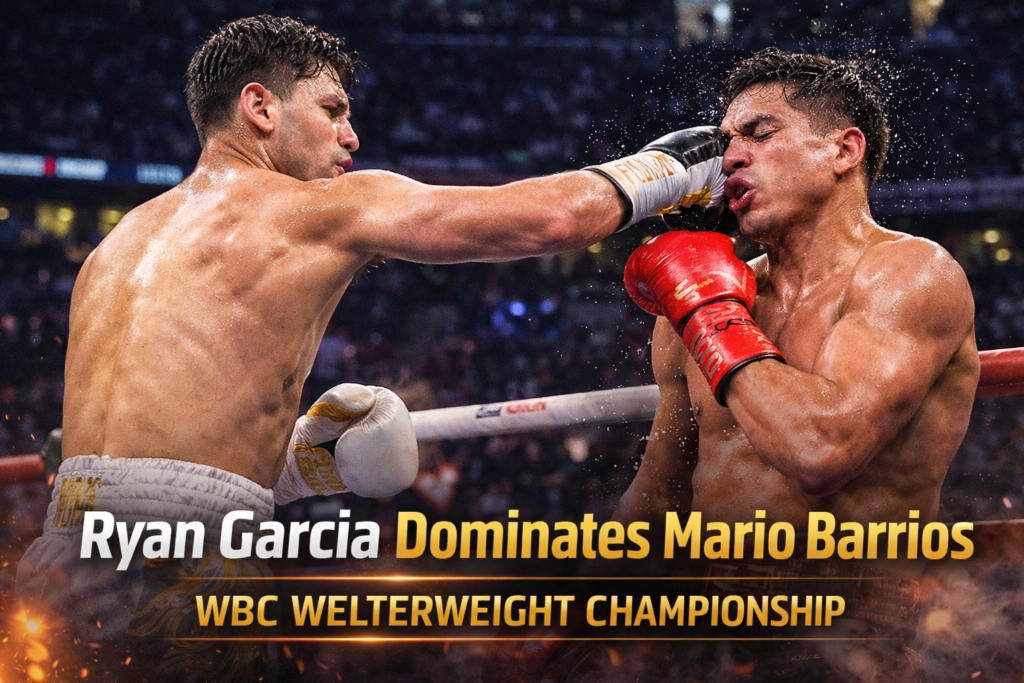
Straight punches pierced the guard with consistency, while short combinations landed before defensive pivots removed any opportunity for retaliation.
By the middle rounds, the difference in clean scoring had become unmistakable. Barrios was working hard. Garcia was working effectively — and effectiveness determines championship outcomes.
Psychological Control Became Increasingly Visible
Physical exchanges tell only part of a fight’s story. Control of tempo and decision-making often reveals the deeper competitive balance.
Garcia dictated pace throughout. Barrios reacted.
The champion chased range rather than commanding it. He followed movement rather than setting traps. He attempted to create exchanges that dissolved before impact.
That constant disruption gradually erodes confidence. As urgency increased, predictability followed — and predictability is dangerous against a fast counterpuncher.
Garcia capitalized on both.
Final Rounds Turned Into Positional Management
Late-fight surges often redefine close contests. This fight never entered that territory.
Garcia adjusted intelligently, emphasizing movement, range control, and risk reduction. Instead of pursuing unnecessary exchanges, he preserved distance and continued scoring from outside engagement range.
Barrios pressed forward with determination, but opportunity never aligned with position. Garcia’s footwork and awareness ensured separation remained intact until the closing bell.
Judges reflected that separation clearly.
Why This Performance Carries Long-Term Significance
Winning a title changes status. The manner of victory changes perception.
Garcia demonstrated tactical patience, defensive awareness, and strategic discipline across a full championship distance. Those traits signal developmental progression — not just physical talent, but competitive maturity.
For a fighter navigating recent inconsistency, this performance redefines trajectory. It suggests stabilization at the elite level rather than volatility within it.
The Welterweight Division Now Faces a New Strategic Problem
Every division adjusts when a champion introduces a difficult style matchup.
Pressure fighters must solve mobility.
Counterpunchers must match speed.
High-volume strikers must exceed efficiency.
Garcia’s approach complicates conventional offensive strategies, forcing opponents to solve positional problems before they can even test physical advantages.
That alone reshapes matchmaking conversations across the division.
A Championship Built Through Control, Not Chaos
Some fights are remembered for dramatic turning points. This one will be remembered for sustained command.
Garcia dictated range.
He dictated pace.
He dictated engagement.
Nothing about the fight unfolded outside his framework. And when a fighter controls structure for twelve rounds, victory becomes inevitable long before it becomes official.
Ryan Garcia didn’t just win the WBC welterweight title.
He demonstrated exactly how he intends to keep it.
Source: https://www.mmanews.com/article/epitome-of-a-shutout-ryan-garcia-dominates-mario-barrios