

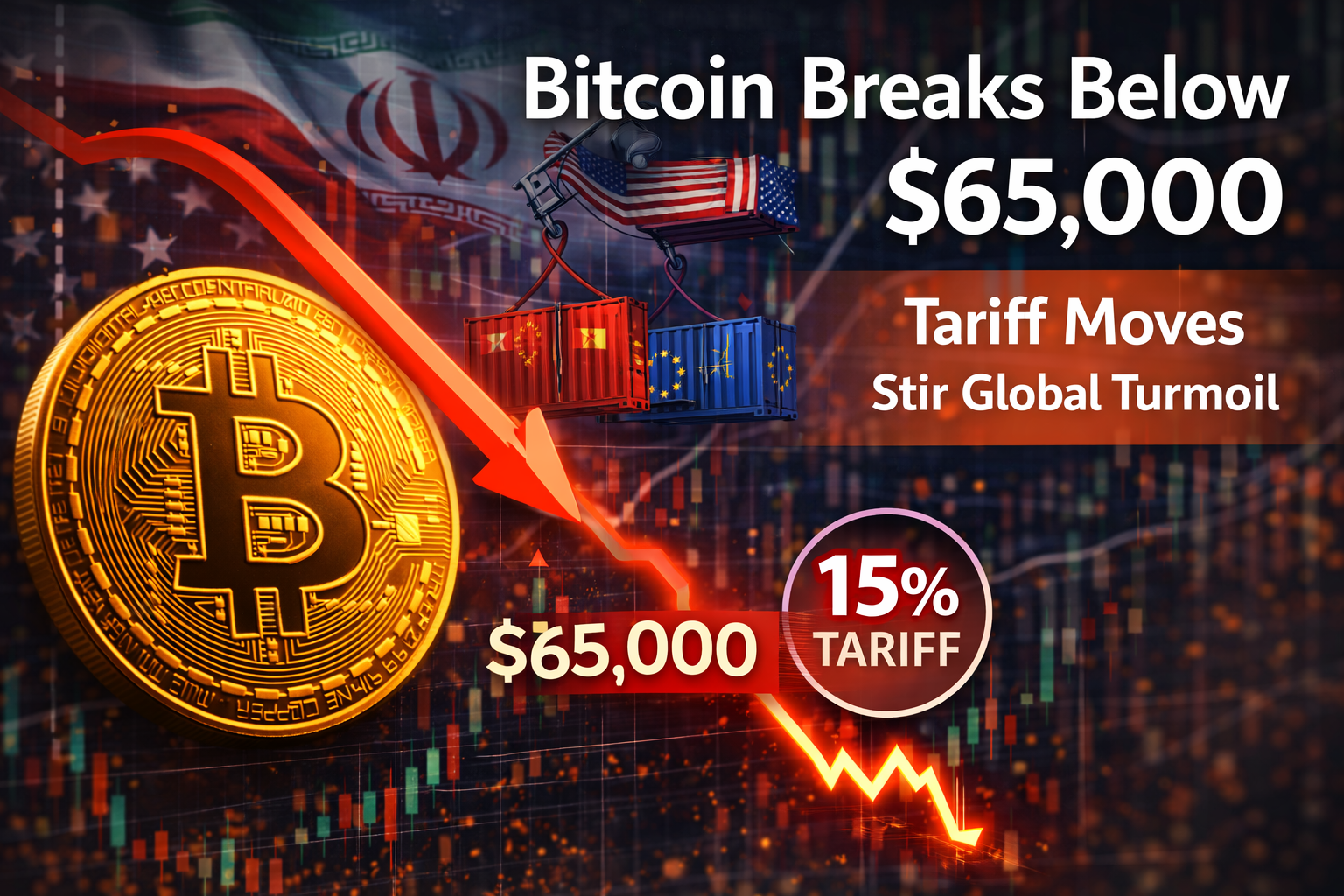
Bitcoin Drops Below $65K as Tariff Shock Triggers Market Liquidity Stress
Bitcoin’s fall below the $65,000 threshold was not simply another volatile trading session. It marked a moment where macroeconomic policy began directly rewriting market positioning across digital assets.
The drop occurred alongside a sudden shift in global risk appetite triggered by aggressive trade policy signals and rising geopolitical tension. Investors did not merely react to price — they reacted to uncertainty about the financial system itself.
When policy unpredictability rises, liquidity becomes fragile.
And when liquidity weakens, crypto is often the first market to reflect it.
The Sell-Off Was Driven by Capital Protection, Not Speculation
Market declines are often explained through technical levels or trader sentiment. This move was different.
Investors rapidly reduced exposure across high-volatility assets as global tariff escalation signaled potential economic slowdown. The response resembled capital preservation behavior rather than speculative repositioning.
In such environments, portfolio managers typically reduce risk simultaneously across multiple asset classes. Bitcoin’s decline aligned with that defensive rotation.
This pattern reflects structural risk management — not emotional panic.

Trade Policy Uncertainty Has Become a Primary Market Variable
Financial markets can absorb interest rate changes, earnings revisions, and economic data. What markets struggle to price efficiently is unpredictable policy intervention.
Tariff escalation introduces several destabilizing forces simultaneously:
- Reduced global trade activity
- Pressure on corporate margins
- Currency volatility
- Reduced investor confidence
These forces create a feedback loop that pushes investors toward liquidity and away from growth-sensitive assets.
Bitcoin, despite its decentralized design, remains deeply influenced by global capital flows. When trade friction rises, capital tightens — and digital assets feel that contraction quickly.
Geopolitical Risk Amplifies Financial Reaction Speed
Military tension does not just increase uncertainty — it accelerates market response time.
Prediction markets and risk models began pricing in potential escalation scenarios, prompting traders to unwind leveraged positions rapidly. When leverage exits quickly, price movement becomes exaggerated.
This is why Bitcoin’s drop appeared sudden rather than gradual.
Leverage unwinds rarely move in slow motion.
The “Digital Gold” Narrative Faces Its Most Difficult Test
For years, Bitcoin has been framed as an alternative safe-haven asset. Recent market behavior challenges that assumption.
Traditional defensive assets — particularly precious metals — strengthened during the same period. Bitcoin moved in the opposite direction.
This divergence suggests investors are currently treating Bitcoin as a liquidity-sensitive asset rather than a protection vehicle.
That distinction matters for long-term positioning models.
Institutional Flows Reveal a Deeper Confidence Shift
Large investors typically signal structural sentiment changes before retail traders react.
Recent ETF flow data indicates sustained withdrawals from Bitcoin investment vehicles. Persistent outflows over multiple weeks suggest more than short-term caution — they indicate reevaluation of exposure levels.
Institutional capital rarely moves quickly without strategic reason.
When it does, the impact is often prolonged.
Liquidity Conditions Now Matter More Than Headlines
While policy announcements triggered the initial move, market depth and liquidity conditions determined its magnitude.
Low liquidity environments amplify volatility because fewer orders are available to absorb selling pressure. When support levels fail under such conditions, price declines accelerate rapidly.
This dynamic is characteristic of transitional market phases rather than stable trends.
Technical Damage Alters Market Psychology
Price levels function as psychological anchors. When widely observed support zones break, investor behavior changes immediately.
The breach of prior buying zones forces market participants to reassess risk tolerance and capital allocation. Confidence becomes conditional rather than assumed.
Once that shift occurs, recovery requires more than price stabilization — it requires rebuilding conviction.
Forward Expectations Are Becoming Increasingly Defensive
Market forecasting models are adjusting downward as volatility persists and liquidity remains constrained.
Lower price projections are not simply predictions — they influence trader positioning in real time. When downside risk becomes consensus expectation, capital deployment slows significantly.
That slowdown reduces market momentum even if selling pressure stabilizes.
The Market Is Entering a Phase of Structural Repricing
What matters most is not how far Bitcoin fell, but why the decline occurred.
The market is not responding to isolated events. It is adjusting to a changing framework of global economic risk, policy unpredictability, and shifting institutional participation.
This is not a typical correction cycle.
It is a repricing of uncertainty.
What Determines the Next Major Move
Recovery will depend less on technical signals and more on three structural factors:
- Stability of global trade policy
- De-escalation of geopolitical risk
- Return of institutional inflows
Until those variables shift, volatility will remain sensitive to macro developments rather than crypto-specific catalysts.
The Real Signal Hidden Inside the Drop
Bitcoin did not fall because demand disappeared.
It fell because certainty disappeared.
Markets can tolerate risk.
They struggle with unpredictability.
The recent price break below $65,000 is best understood not as weakness in crypto — but as stress in the broader financial environment.
And that stress is still unresolved.
Source: https://cryptonews.com/news/bitcoin-price-falls-below-65k-trump-tariff-risk-off/