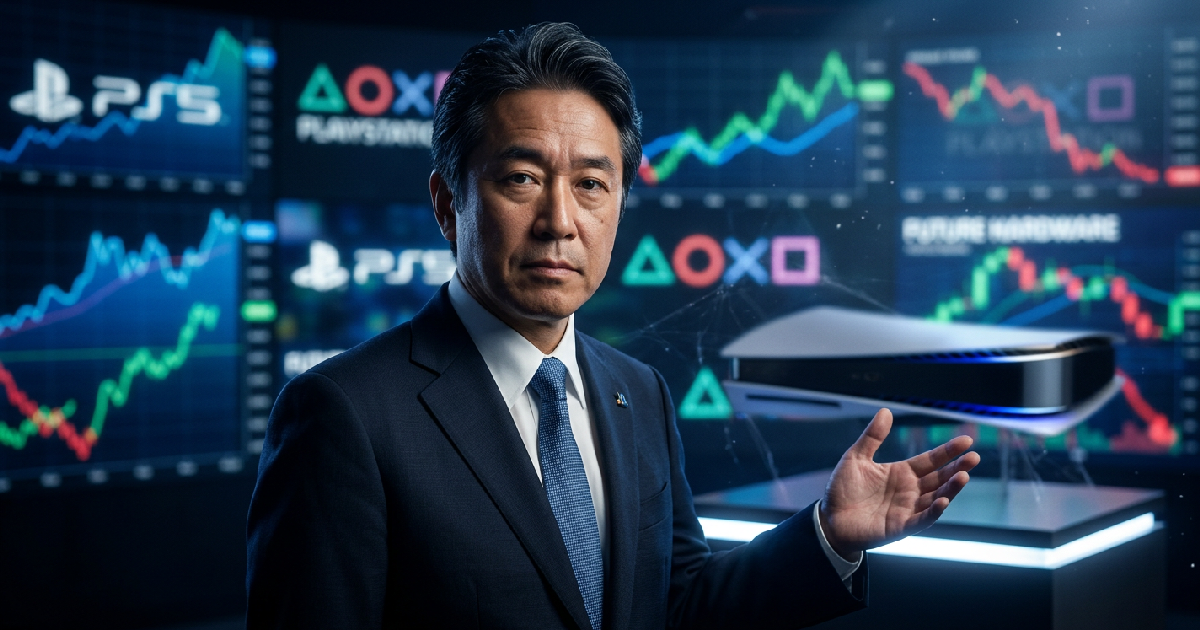
Sony Interactive Entertainment President and CEO Hiroki Totoki recently flagged a potential shift in the company’s long-term hardware strategy, citing a looming pricing crisis that could redefine the launch of the PlayStation 6. Speaking to investors during a recent briefing, CEO Hiroki Totoki admitted that the manufacturer has not yet finalized a release window or a price point for its next-generation console. The hesitation reportedly stems from a volatile semiconductor market where the AI-driven demand for memory chips is inflating the cost of RAM and storage components, threatening to push the retail price of a future PS6 well beyond traditional consumer expectations.
The logic behind this caution is rooted in the current struggle to maintain affordable gaming hardware. While the PlayStation 5 has seen success,
Sony raises PS5 price in Europe and Japan in response to global economic pressures, which has led to speculation that the era of highly subsidized, low-cost consoles may be coming to an end. If the costs of high-performance components remain elevated through the upcoming financial cycles, some reports suggest a PlayStation 6 built on current architecture might debut at a price point significantly higher than previous generations. For a company that built its empire on accessible consumer electronics, such a figure represents a difficult challenge for the mass market.
Evaluating the shift in PlayStation business models
The core of the problem lies in Sony’s traditional “razor and blade” model where hardware is often sold at thin margins to build a massive user base that generates profit through digital software sales and subscriptions. But if the console becomes too expensive for the average household to purchase upfront, the entire ecosystem faces potential disruption. CEO Hiroki Totoki noted that the firm is currently running various simulations to address this, suggesting that the very way people buy a PlayStation could fundamentally change.
One potential path forward involves adopting a contract-based model similar to the smartphone industry. Instead of a single upfront payment, players might receive a PS6 as part of a multi-year PlayStation Plus commitment, paying a monthly fee that covers both the hardware and the service. While Microsoft previously attempted this with Xbox All Access, the program reportedly struggled to gain significant traction. But as hardware costs move closer to the price of flagship mobile devices, the necessity for financing or subscription-based schemes becomes more apparent for the gaming sector.
The role of cloud gaming and infrastructure
Beyond financing, Sony is reportedly looking at more radical departures from physical hardware. If the cost of manufacturing a high-end box becomes prohibitive, a shift toward a cloud-first strategy might be considered a viable way to sustain growth. This would involve users streaming games directly to smart TVs or low-cost devices, with Sony hosting the heavy-duty computing power in its own data centers. While the company has invested in its cloud infrastructure, transitioning away from a signature box would be a significant cultural and technical shift for the brand.
This uncertainty comes at a time when the broader tech and finance sectors are also grappling with high-stakes shifts. Just as
Sony raises PS5 prices again to offset inflation, other markets are seeing similar volatility. For instance, the digital asset space continues to feel the sting of hardware and liquidity shifts, as major digital currencies have seen
liquidations that ripple through the tech investment landscape. These macroeconomic headwinds make it increasingly difficult for Sony to commit to a traditional hardware life cycle.
Future of the traditional console cycle
Perhaps the most subversive strategy currently under consideration is the possibility of delaying the generational leap. Usually, a console cycle lasts for several years before a successor is required to keep up with visual and processing demands. However, the diminishing returns on graphical fidelity, combined with the soaring costs of game development, have led some analysts to wonder if the PlayStation 5 might have a much longer lifespan than its predecessors.
By extending the life of current hardware through software optimization and mid-cycle refreshes, Sony could avoid the financial risk of launching an expensive successor into an unfriendly economy. The company’s biggest profit drivers are now digital content and add-ons rather than the hardware itself. If the PS5 can continue to provide a gateway to these services, the urgency to release a successor diminishes. This approach would allow Sony to wait for manufacturing costs to potentially stabilize.
The gaming market is clearly facing pressure from supply chain realities. While software continues to thrive — exemplified by titles that arrive on PC via Steam to broaden their reach — the hardware that defined the last few decades is at a crossroads. Whether the PlayStation 6 arrives as a premium luxury item or a subscription-bound device, the decision will likely redefine Sony’s identity as a consumer electronics giant.