

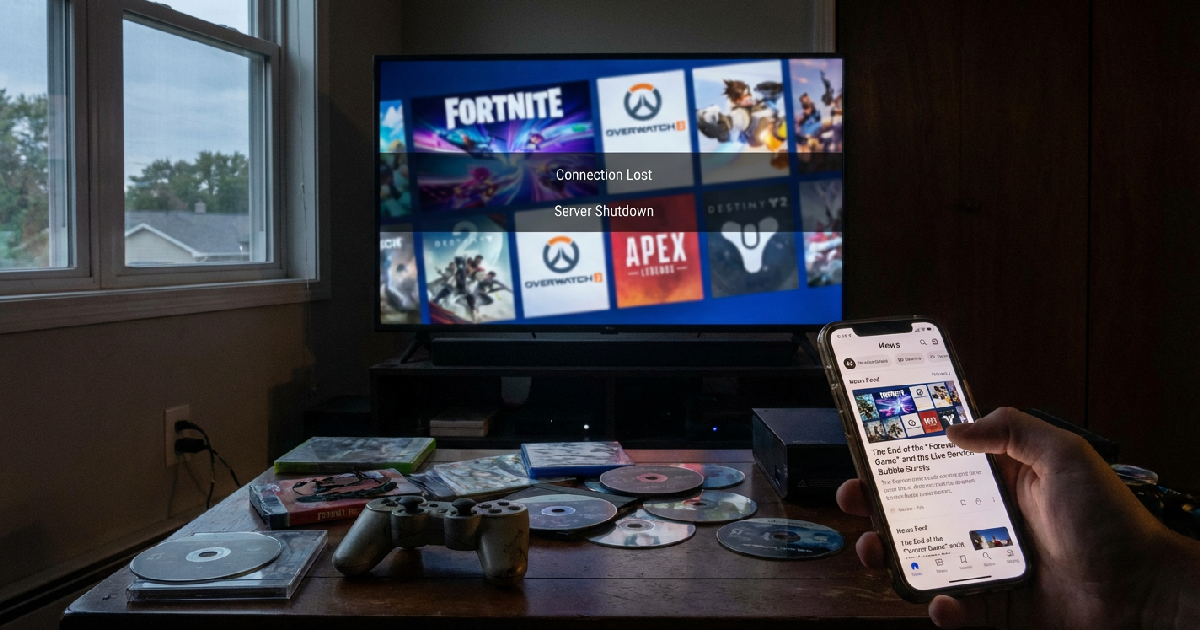
Live Service Dreams Fade as the Forever Game Model Dies
For more than ten years, the term “Forever Game” was the holy grail of the video game industry. It described a specific type of project: a live-service title designed to be played, monetized, and updated indefinitely. But as we move through early 2026, the industry is witnessing a brutal correction. The dream of the eternal revenue stream is fading, replaced by a graveyard of shut-down servers and bloated budgets that never found their footing.
The catalyst for this shift isn’t just one failure, but a cumulative exhaustion among players and investors alike. Major publishers, who once chased the multi-billion dollar success of Fortnite or Call of Duty: Warzone, are finding that the market simply cannot sustain dozens of “infinite” games simultaneously. There are only so many hours in a day, and the digital shelf space is finally full.
The Saturation Point of Live Services
The logic was once simple: build an ecosystem, sell a battle pass, and keep the player hooked for years. PlayStation famously leaned into this strategy recently, promising a massive slate of live-service titles. However, the reality of development has proven far more difficult. High-profile projects that spent years in development have been quietly cancelled or pivoted back to single-player experiences after witnessing the cooling reception to titles that prioritize “retention” over “fun.”
Even stalwarts like Overwatch and Fortnite have had to reinvent themselves repeatedly just to tread water. While Epic Games’ flagship title remains a cultural phenomenon, it has pivoted from a simple battle royale to a platform for other games—essentially a digital storefront disguised as a virtual world. This evolution highlights a core problem: if you aren’t the top game in the world, the “Forever” model is a financial deathtrap.
And it’s not just about the games themselves. The economic environment of 2026 has made investors far more cautious. Gone are the days of “growth at any cost.” Today, if a game doesn’t show a clear path to profitability within its first six months, the plug is pulled with a ruthless efficiency that was unheard of five years ago.
PlayStation and the Pivot to Premium
Sony’s PlayStation division provides the most interesting case study in this ideological shift. After a period of aggressive pivoting toward live service, there is a visible return to the “prestige” single-player experiences that defined the PS4 era. The cost of maintaining a live-service game—the constant updates, server costs, and community management—often outweighs the revenue if the player base isn’t in the tens of millions.
We are seeing a renewed appreciation for games that actually end. There is a growing segment of the market that finds the endless grind of Call of Duty or the seasonal cycle of shooters to be more of a chore than a pastime. Publishers are rediscovering that a polished, twenty-hour experience can often yield better margins and long-term brand loyalty than a “Forever Game” that dies in eighteen months.
The Competitive Fatigue of eSports and Online Loops
The e-gaming sector is feeling this pressure too. Competitive integrity is often sacrificed at the altar of “new content,” as developers feel forced to shake up the meta every few weeks to keep casual players buying skins. This has led to a drain of veteran talent in games like Overwatch, where the balance between a competitive esport and a casual live-service product has become increasingly precarious.
Players are also becoming “subscription fatigued.” When every game requires a monthly pass or a daily login to avoid missing out on limited-time rewards (FOMO), the psychological toll eventually leads to burnout. Many gamers are opting out entirely, returning to independent titles or older, static games where the experience remains consistent.
What Happens to Our Digital Libraries?
The death of the Forever Game brings up a chilling question about digital ownership. When these games fail, they don’t just stop getting updates; they often become unplayable. We have seen several high-profile titles vanish from digital storefronts this year, leaving players with nothing but memories of the money they spent on virtual cosmetics. This trend is sparking a new wave of consumer advocacy, with players demanding “offline modes” as a standard requirement for any game that might eventually lose its server support.
As we look toward the remainder of 2026, the industry seems to be settling into a hybrid model. The mega-hits will survive, but the mid-tier “Forever Game” is likely a thing of the past. The era of trying to own a player’s entire life is ending; the era of respecting a player’s time might finally be arriving.
Frequently Asked Questions
Are games like Fortnite and Call of Duty actually going away?
No, the industry leaders are safe for now because they have the scale to survive market contractions. The “death” of the Forever Game refers to the trend of every new game trying to copy that model. Smaller and mid-sized studios are moving away from the live-service format because the competition is too fierce.
Is PlayStation stopping its focus on online games?
Reports suggest a significant rebalancing. While Sony hasn’t abandoned online play, they have reportedly cancelled or delayed several live-service projects to focus on their core strength: high-quality, narrative-driven single-player games that don’t require an infinite timeline to be profitable.
Why is the live-service model failing now after a decade?
It comes down to market saturation. Players only have time for one or two “main” games. With hundreds of games competing for that same limited time, the cost of acquiring and keeping a player has skyrocketed, making it nearly impossible for new live-service games to break even.