

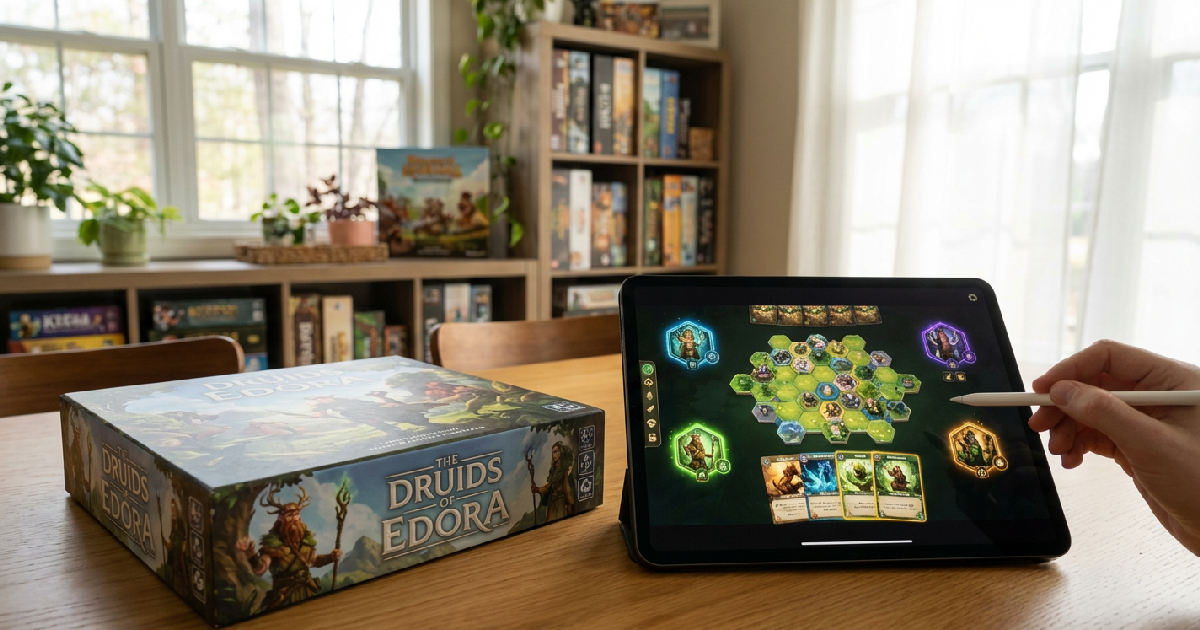
The Druids of Edora digital review assesses tabletop port
The transition from a dense, complex board game to a streamlined digital experience is a challenge that has tripped up many developers. However, the latest digital adaptation of The Druids of Edora, as explored by recent critical assessments from GamesReviews.com, suggests that depth doesn’t always have to be sacrificed for the sake of a user interface. As tabletop gaming continues its expansion into the digital realm, this specific title serves as a barometer for how tactical systems are currenty evolving.
Set in a mythic world where players manage resources to protect a sacred forest, The Druids of Edora is built on a foundation of worker placement and engine-building mechanics. While the physical version gained a following for its quality components and intricate card interactions, the question for the digital release was whether a screen could capture the same sense of environmental tension.
Mechanical Depth Meets Digital Fluidity
One of the standout features noted in current assessments of the game is its seasonal cycle mechanic. In each phase of gameplay, the board state shifts to reflect changing weather and resource availability. In a physical setting, this requires constant manual adjustments of tokens and boards. The digital version automates these tasks, allowing players to focus on the strategic implications of a localized drought or an early frost.
But the automation goes beyond just moving pieces. The game’s AI-driven opponents have been highlighted for their ability to react to player strategy. If a player over-harvests a specific sector of Edora, the AI reportedly shifts its strategy to capitalize on the resulting ecological imbalance. It is a dynamic that feels more responsive than a standard tabletop “automa” deck, bridging the gap between traditional board gaming and modern strategy video games.
Component Quality and Visual Fidelity
For many enthusiasts, the draw of The Druids of Edora lies in its aesthetic. The digital port maintains the hand-painted art style that defined the original, but adds subtle animations that bring the forest to life. These visual flourishes help communicate game states—such as a “blighted” tile—effectively compared to a standard cardboard token.
The user interface has reportedly undergone several iterations to ensure that the significant amount of data—ranging from mana pools to seasonal modifiers—remains legible on smaller screens. This is a common pain point for ports of “Euro-style” board games, where information overload can alienate new players. The solution here appears to be a tiered information system where specific card details only pop up when hovered over or selected.
| Game Feature | Physical Version Detail | Digital Version Implementation |
|---|---|---|
| Resource Management | Manual token tracking | Automated ledger with history |
| Seasonal Shifting | Manual board reconfiguration | Real-time visual map updates |
| Player Count | Standard group play | Expanded online and local play options |
| Tutorial System | Extensive printed rulebook | Interactive “Learning Forest” scenario |
Expanding Accessibility in the Current Market
Strategic gaming is seeing a surge in cross-platform interest, and The Druids of Edora fits into this trend. By offering a lower barrier to entry than its more expensive physical counterpart, the digital version acts as a gateway. It allows the core mechanics to reach a demographic that might not have the table space or the consistent group of friends needed for a lengthy board game session.
And while some purists argue that the “soul” of the game is lost without the tactile feel of the wooden druid pawns, the inclusion of ranked matchmaking and asynchronous play offers something the physical box cannot: a constant stream of opponents. This competitive element is expected to sustain the game’s longevity in the coming months.
Future Content and Updates
Looking ahead, the roadmap for Edora suggests that the digital platform will serve as a testing ground for new expansions. There are reports that a new “Coastal Tide” mechanic may be introduced digitally before it ever sees a print run. This “digital-first” expansion strategy is becoming more common among publishers who want to gather player data and balance mechanics before committing to manufacturing costs.
Whether you are a veteran of the tabletop scene or a newcomer looking for a deep strategy hook, this adaptation seems to respect the source material while utilizing the advantages of its new medium. It isn’t just a basic port; it is a refined version of an already respected title.
Frequently Asked Questions
Is there a single-player mode for those who prefer solo play?
Yes, the game features a solo campaign that specifically focuses on restoring different regions of Edora. The AI is designed to mimic different playstyles, from aggressive resource-gatherers to passive engine-builders.
Can I play against friends who are using different platforms?
The developers have prioritized cross-play functionality. This means players on PC can compete against those on other supported platforms without any loss of features, which is essential for keeping the matchmaking pools healthy.
Does the digital version include all the expansions from the board game?
Reports indicate the launch version includes the core “World Tree” set and the first major expansion. Further modules are expected to be added in the coming months as downloadable content to mirror the physical release schedule.