

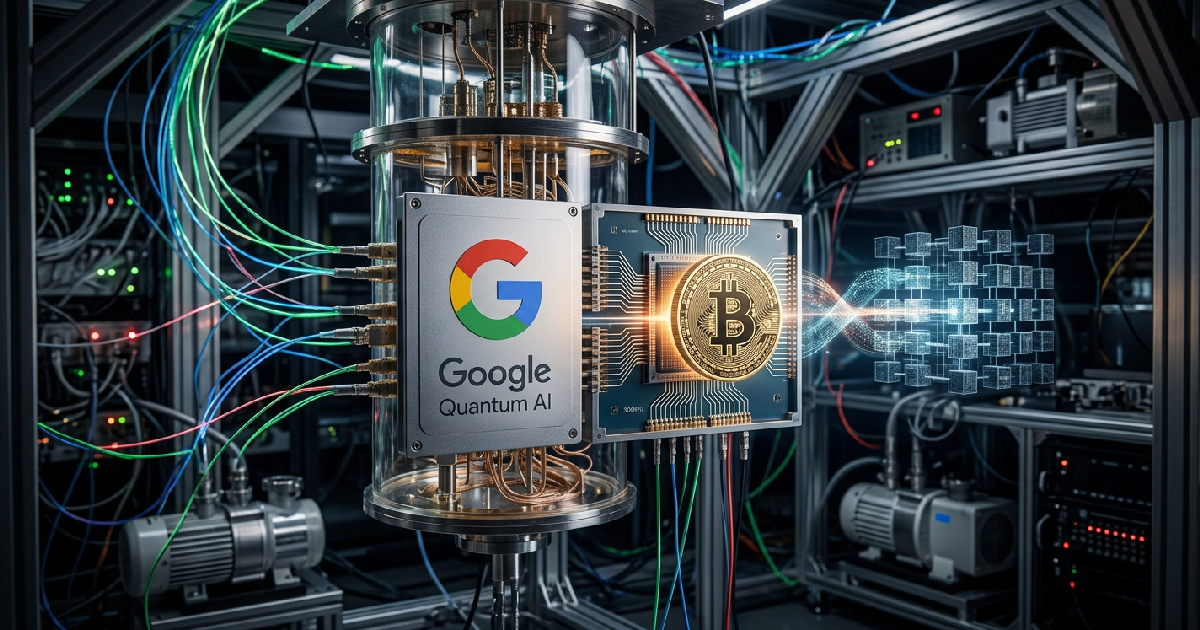
Google quantum research targets Bitcoin over banking codes
Google’s latest leap in quantum computing has sent a ripple through the digital asset world, though perhaps not for the reasons most observers expected. While traditional doomsday scenarios often link quantum breakthroughs to the cracking of nuclear launch codes or the total subversion of global banking systems, Google’s research team appears to be focusing its sights specifically on the cryptographic foundations of Bitcoin.
The reasoning behind this shift is grounded in practical mathematics rather than geopolitical drama. Banking systems, despite their size, rely on centralized protocols and human intervention layers that can be updated or patched. Bitcoin, conversely, represents a “pure” cryptographic target—a decentralized, immutable ledger that relies entirely on ECDSA (Elliptic Curve Digital Signature Algorithm). For researchers at Google, Bitcoin isn’t just a currency; it is the ultimate benchmark for testing the efficacy of Shor’s algorithm on a global scale.
Why Google is targeting the Bitcoin network
In the hierarchy of encryption, the security shielding modern banking is often a messy mix of legacy code and multi-factor authentication. Bitcoin is different. Every transaction is transparent, and every wallet is protected by mathematical puzzles that are currently impossible for classical computers to solve within the lifetime of the universe. However, quantum computers operate on a different plane of logic.
Google’s research suggests that Bitcoin’s public-key infrastructure provides the most legible “litmus test” for quantum supremacy. If a quantum computer can successfully derive a private key from a public address, the entire premise of blockchain security evaporates. This focus serves a dual purpose: it allows Google to measure its hardware against the most robust public encryption standard in existence, while simultaneously signaling to the tech world that the “Quantum Winter” for current cryptography may be approaching sooner than anticipated.
But the focus isn’t philanthropic. By selecting Bitcoin as the primary research subject, Google is engaging with a system that has no “customer support” or “central bank” to roll back transactions if a breach occurs. It is the most unforgiving environment imaginable for a security audit.
The vulnerability of old Bitcoin wallets
Not all Bitcoin is created equal in the face of a quantum threat. The research highlights a specific vulnerability in “Pay to Public Key” (P2PK) addresses—the type used by Satoshi Nakamoto and early miners. In these older addresses, the public key is already exposed on the blockchain. Modern P2PKH (Pay to Public Key Hash) addresses are slightly more resilient because the public key isn’t revealed until a transaction is actually sent.
This creates an interesting dynamic within the market. If Google or any entity achieves a functional quantum advantage, the massive “Satoshi bags” totaling roughly one million BTC could become the first visible targets. The psychological impact of seeing a dormant 2009 wallet drained by a quantum computer would likely do more damage to the market than any regulatory crackdown in Washington.
This research comes at a time of broader market uncertainty. As we’ve seen in recent analysis regarding Bitcoin’s volatility spikes, the market is already on edge regarding the long-term technical viability of the asset class. Google’s research only adds a new, more existential layer to that tension.
Post-quantum cryptography and the path forward
The Bitcoin community isn’t sitting idle. Developers are already discussing the implementation of Lamport signatures and other post-quantum cryptographic (PQC) standards. The challenge is that Bitcoin is notoriously difficult to change. Achieving a consensus-led soft fork to upgrade the network’s security would be a Herculean task, potentially taking years to coordinate across thousands of independent nodes.
Google’s findings imply that the window for this transition might be narrowing. While we are likely still years away from a quantum computer with enough stable qubits to crack a 256-bit key, the research indicates that the methodology is maturing rapidly. This aligns with the broader industry sentiment that digital assets are facing a final test for global utility. If Bitcoin cannot evolve to withstand quantum pressure, it risks becoming a historical footnote rather than a permanent store of value.
For now, the banking sector can breathe a sigh of relief. The complexity of their systems actually provides a “security through obscurity” that Bitcoin lacks. In the transparent world of the blockchain, there is nowhere to hide from a sufficiently powerful laser or a perfectly cooled qubit.
Common questions about Quantum computing and Bitcoin
Does this mean my Bitcoin is at risk today?
No. Current quantum computers do not have the necessary qubit count or error correction to crack Bitcoin’s 256-bit encryption. Google’s research is focused on the theoretical and experimental milestones required to get there, not an immediate attack.
Can’t Bitcoin just update its code to be quantum-proof?
Yes, it can. Bitcoin can be upgraded through a soft fork to include quantum-resistant signature schemes. The difficulty lies in the logistics: users would have to manually move their funds to new, secure addresses, and inactive wallets—like those belonging to Satoshi—would remain vulnerable.
Why is this more important than nuclear codes?
Nuclear launch protocols are protected by multiple layers of “air-gapped” security, physical keys, and human authorization. Bitcoin relies 100% on a specific mathematical formula. If you break the formula, you own the network instantly, making it a much more “elegant” target for scientific research.