By Jerry Hugh
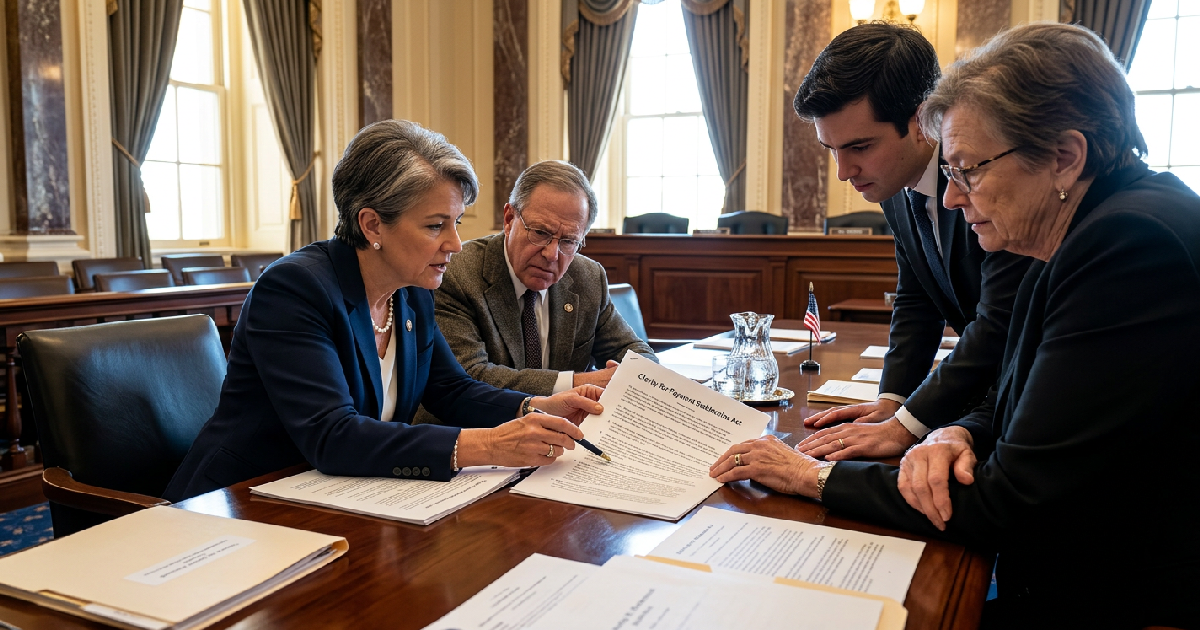
Analysts from investment banks TD Cowen and Benchmark issued fresh warnings regarding the legislative path for the crypto market structure bill, asserting that despite a successful Senate committee vote, the initiative faces major political headwinds. The analysts reportedly revised their expectations for the bill’s passage, noting that while the preliminary victory is a positive step, the legislation still requires significantly broader bipartisan support to reach the President’s desk. The report specifically highlights the Clarity for Payment Stablecoins Act as a primary area where Democratic consensus remains elusive.
The recent committee victory marks the first time this specific framework for digital assets has cleared a major Senate hurdle. However, the legislation remains hampered by deep-seated disagreements over consumer protection standards and the division of authority between federal and state regulators. This regulatory stalemate persists even as digital assets become more deeply embedded in global finance, a trend highlighted in recent reports on
global capital flows for stocks, bonds, and crypto.
Analysts emphasized that while the probability of the bill passing has technically improved, it remains an uphill battle for the current session. The legislative calendar is rapidly shrinking as other priorities take center stage. Any proposal that fails to secure a clear majority in the coming weeks risks being sidelined in favor of mandatory spending bills and other high-priority fiscal matters.
Benchmark Identifies Lack of Support from Key Democrats
Focusing on the Clarity for Payment Stablecoins Act, Benchmark analysts argued that the current text lacks enough support from influential Democratic leaders to ensure a floor vote. The bill needs to bridge the gap between those who prioritize innovation and those who demand strict investor protections. This tension is most visible in the debate over whether the Securities and Exchange Commission (SEC) or the Commodity Futures Trading Commission (CFTC) should serve as the primary industry watchdog.
Market conditions often dictate the pace of Congressional action. When
liquidity drops and Bitcoin prices slide, the pressure on lawmakers to provide clarity usually intensifies. Analysts suggest that without industry concessions on transparency and oversight, the current bill will likely stall before it ever reaches a full floor vote in the Senate.
The official list of bill cosponsors and the specific schedule for the full Senate floor debate have not yet been announced. This lack of a clear timeline adds to the uncertainty for market participants who are looking for a definitive move toward a regulated environment.
Financial Consequences of Regulatory Uncertainty
The struggle in Washington D.C. has direct consequences for the financial health of digital asset firms. Ongoing uncertainty makes it difficult for companies to manage their balance sheets without fear of retroactive enforcement actions. For example,
BitGo recorded a fourth-quarter loss recently as its Bitcoin treasury valuation fell, demonstrating how even established players are vulnerable to market swings while waiting for a defined legal framework.
If the Senate fails to move forward, analysts expect the current “regulation by enforcement” strategy to persist. This environment typically fuels market volatility. Historically, sharp drops in the price of lead assets have caused a domino effect, where falling prices drag down the valuations of crypto-linked stocks and infrastructure providers throughout the sector.
Proponents of the market structure bill argue that clear definitions for tokens—separating them into distinct categories like securities or commodities—would unlock substantial institutional investment. Currently, many large-scale funds remain on the sidelines, citing the lack of legal certainty as a primary barrier to entry.
Negotiations Over State versus Federal Oversight
The next phase of negotiations will focus on the division of power between state and federal authorities. Many Democratic lawmakers are advocating for a robust federal mandate to prevent inconsistent standards across different jurisdictions. Conversely, many Republicans seek to protect the existing licensing regimes in states that have already developed comprehensive regulatory structures.
Industry advocates have reportedly spent recent weeks lobbying for a middle-ground solution, but the window for action is closing. Both TD Cowen and Benchmark analysts agree that if a bipartisan consensus is not reached by the summer recess, the bill will likely be deferred until after the next election cycle. For now, the crypto industry is forced to wait, watching to see if the initial committee success can be converted into actual law.