

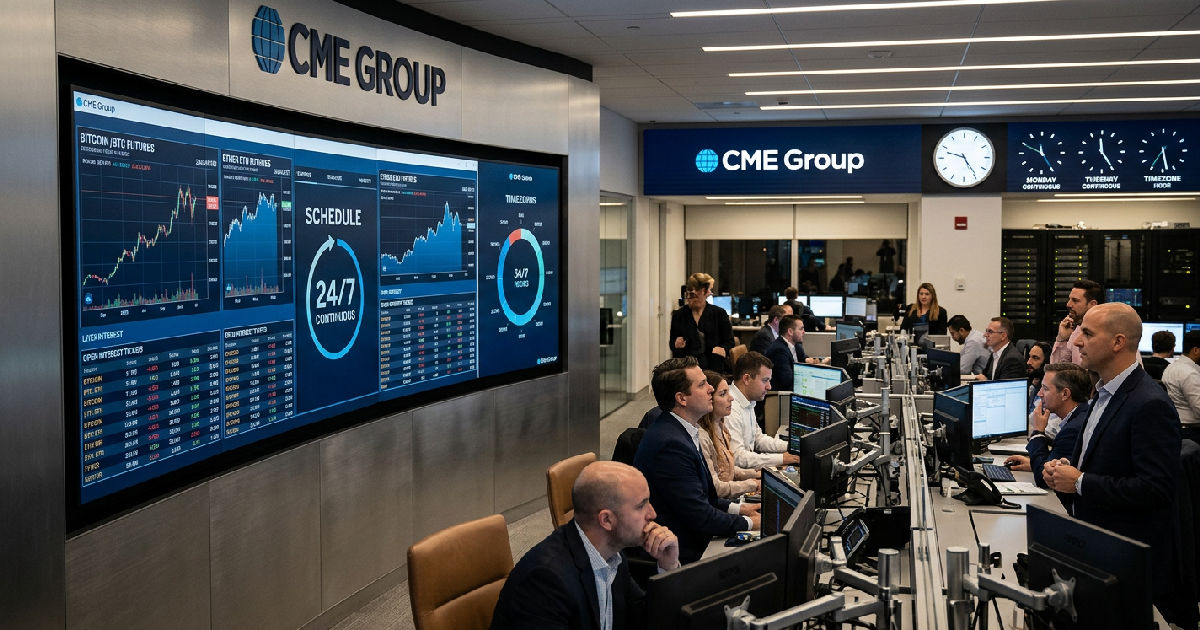
CME Group plans 24-hour crypto futures trading from May 29
The boundary between traditional finance and the digital asset market is blurring further as CME Group moves to synchronize its operations with the non-stop nature of the blockchain. In an announcement shared via its official social media channels, the derivatives giant confirmed plans to transition its cryptocurrency futures and options products to a 24-hour trading cycle beginning May 29.
Currently, while the underlying spot markets for Bitcoin and Ether trade 24/7 across global exchanges, CME’s regulated derivatives have remained bound by more traditional exchange hours. This discrepancy often creates “gaps” in price action over weekends or during late-night shifts in liquidity, leaving institutional traders exposed to volatility they cannot easily hedge in real-time. The proposed shift aims to align the world’s largest regulated derivatives marketplace with the reality of an asset class that never sleeps.
Closing the Weekend Gap
For years, institutional investors have navigated the “CME Gap”—the price difference between Friday’s close and Sunday’s open. When major news breaks on a Saturday morning, CME traders have been forced to wait until the start of the next trading week to adjust their positions. This delay often leads to frantic price discovery at the open, sometimes resulting in liquidations or missed opportunities for those using CME products for risk management.
By moving to a 24-hour schedule, CME Group is effectively removing one of the last major hurdles for institutional adoption. It allows hedge funds and corporate treasuries to respond to global macroeconomic shifts or crypto-specific events the moment they happen. But this transition isn’t just about convenience; it’s about market efficiency. Continuous trading reduces the risk of massive “slippage” during market restarts and provides a more accurate reflection of the asset’s value at any given moment.
This development follows a period of heightened interest in regulated crypto products. As Bitcoin enters a period of technical narrowing, the demand for sophisticated hedging tools like options has surged. CME’s decision suggests the exchange is seeing enough consistent volume from global time zones to justify the logistical and operational costs of 24-hour coverage.
The Regulatory Hurdle
While the May 29 date is marked on the calendar, CME Group was careful to note that the rollout remains “contingent on regulatory approval.” The Commodity Futures Trading Commission (CFTC) will need to sign off on the change, ensuring that the exchange has the necessary oversight and risk management protocols in place to handle overnight trading without disruption.
The move comes at a time when the regulatory environment for digital assets is under intense scrutiny. Other legislative efforts, such as the New Clarity Act’s impact on stablecoin yields, show that Washington is still actively debating the rules of the road for the broader industry. However, CME Group has a long history of cooperation with the CFTC, and as a heavily regulated designated contract market (DCM), it is well-positioned to meet the agency’s requirements for expanded hours.
What This Means for Retail and Institutional Liquidity
Many traders believe the institutionalization of crypto is a zero-sum game, but CME’s expansion could prove otherwise. As professional desks trade through the night, the increased liquidity often trickles down to the spot markets used by retail investors. Spreads tend to tighten and price discovery becomes more robust when there is a regulated benchmark trading in tandem with offshore exchanges.
And yet, 24-hour trading brings its own set of challenges. Market participants will need to bolster their automated monitoring systems and ensure they have “eyes on” during formerly dead hours. The move also signals that the “professionalization” of crypto is entering its next phase. We are moving away from the era of crypto as a speculative side-bet and toward its status as a permanent fixture of the global financial plumbing.
Whether this leads to a broader shift in institutional appetites remains to be seen, but for now, the “wait for the open” era for CME crypto traders appears to be coming to an end.
Common Questions About CME 24-Hour Trading
Will this apply to all CME crypto products?
According to the announcement, the 24-hour schedule is intended for both crypto futures and options on futures. This means the flagship Bitcoin and Ether contracts, as well as their “micro” counterparts, will likely be included in the shift.
Why does the May 29 date depend on regulatory approval?
Expanding trading hours involves changes to clearinghouse procedures, risk management, and surveillance. The CFTC must review these changes to ensure they don’t pose a systemic risk to the market or lead to unfair advantages for certain participants.
How does this affect the price of Bitcoin?
While it doesn’t change the fundamental value of Bitcoin, it can reduce volatility spikes that happen at the “market open” on Sunday evenings. By allowing for continuous price discovery, the market can absorb news more smoothly over the weekend rather than reacting all at once when the bell rings.