

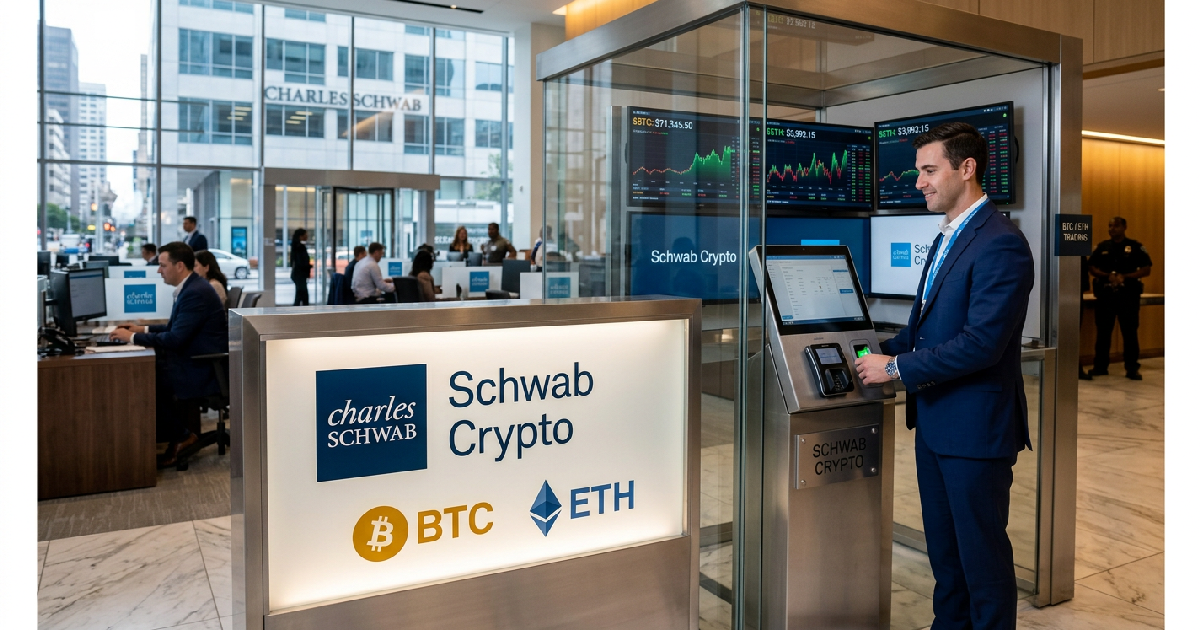
Charles Schwab launches crypto trading service for BTC and ETH
The institutional barriers around the digital asset market continue to dissolve. Charles Schwab, the brokerage powerhouse overseeing roughly $12 trillion in assets under management, has officially stepped into the arena with the launch of its dedicated cryptocurrency trading service.
Operating under the banner of Schwab Crypto, the firm is now offering direct access to Bitcoin (BTC) and Ethereum (ETH) for its massive retail and advisor client base. The move marks a pivot for the Texas-based financial giant, which had previously taken a conservative stance toward direct digital asset custody, instead steering clients toward exchange-traded funds (ETFs) and crypto-adjacent equities.
The rollout covers almost the entirety of the United States, though regulatory friction remains a factor. Schwab confirmed that the service will be available in 48 states, with New York and Louisiana currently excluded from the platform’s initial launch phase.
A Strategic Shift for a Financial Heavyweight
For years, Schwab’s leadership maintained that they would only offer direct crypto trading when regulatory clarity improved or client demand became impossible to ignore. It appears both conditions have now been met. By integrating Bitcoin and Ethereum into its core ecosystem, Schwab is effectively legitimizing these assets as standard portfolio components for the average American investor.
The timing is particularly relevant given the tightening competition in the “wealth-tech” space. As rivals like Fidelity and specialized crypto platforms successfully captured early market share, Schwab risked losing younger, tech-savvy investors who prioritize having all their assets—stocks, bonds, and crypto—under a single roof. This launch isn’t just about providing a new product; it’s about retention in an increasingly fragmented brokerage market.
But this isn’t a “move fast and break things” play. By limiting the initial offering to the two largest assets by market capitalization, Schwab is playing it safe. They are avoiding the regulatory minefields associated with “altcoins” while focusing on the two assets that have already received a silent nod from most global financial regulators.
Regional Restrictions and Regulatory Hurdles
The exclusion of New York and Louisiana highlights the complex patchwork of state-level crypto regulations that still plague the U.S. industry. New York’s rigorous “BitLicense” requirements and Louisiana’s evolving stance on digital asset service providers likely presented administrative hurdles that Schwab decided to bypass for the sake of an immediate national launch.
Investors in these states are likely used to this treatment. Many centralized exchanges have historically delayed launches in New York due to the state’s high compliance barrier. However, for a firm of Schwab’s scale, the expectation is that they will eventually secure the necessary licensure to bring “Schwab Crypto” to all 50 states.
This development comes as the broader industry faces a “utility or obsolescence” moment, as explored in recent analysis regarding the final test for global digital asset utility. Schwab entering the fray suggests that the “utility” side of that argument is winning out among the institutional elite.
What the Schwab Entry Means for Market Volatility
Critics often argue that institutional entry leads to the “commoditization” of Bitcoin—turning it into just another ticker symbol that moves in tandem with the S&P 500. While that may be true for price action, the liquidity benefits of $12 trillion in assets potentially trickling into BTC and ETH cannot be understated.
We are seeing a trend where traditional gates are opening. For instance, Morgan Stanley recently expanded Bitcoin access for its wealth clients, and Schwab’s move follows a similar logic. The barrier to entry for a 60-year-old traditional investor to buy $5,000 worth of Bitcoin has just been lowered significantly.
The wider market impact will likely be felt in the coming quarters. If Schwab’s users begin allocating even 1% of their portfolios to these new offerings, the buy-side pressure could provide a significant floor for prices during periods of market stress. Conversely, it ties the crypto market even closer to the traditional financial cycle, making it more sensitive to Fed interest rate decisions and broader economic data.
Future Expansion and The Altcoin Question
Will Schwab eventually add Solana, XRP, or Cardano? For now, the firm is silent. Given the new Clarity Act rules affecting stablecoins and other digital assets, the brokerage is likely content to sit on the sidelines of the more speculative “DeFi” market. Bitcon and Ethereum are the safe bets, and for a legacy firm like Schwab, safety is the primary brand value.
As the service matures, the next logical step would be the integration of these holdings into Schwab’s managed portfolio services and advisor tools. This would allow financial advisors to rebalance crypto holdings alongside traditional ETFs, a feature that has been a “holy grail” for crypto-focused wealth managers for years.
Frequently Asked Questions
Can I transfer my existing Bitcoin from a private wallet into Schwab?
Initially, most traditional brokerages launch with “closed loop” systems, meaning you can buy and sell within the platform but cannot deposit or withdraw the underlying assets to a private wallet. Schwab has not yet clarified if full “on-chain” deposits and withdrawals will be supported at launch.
Are my crypto holdings insured by the SIPC?
No. The Securities Investor Protection Corporation (SIPC) protects against the loss of cash and securities if a brokerage firm fails. However, crypto assets are generally not considered protected securities under current SIPC rules. Investors should review Schwab’s specific custody insurance policies.
Why are New York and Louisiana excluded from the launch?
These states have specific and often more rigid regulatory frameworks for digital asset businesses. Schwab has likely chosen to launch in the 48 states where they already meet all compliance requirements rather than delaying the entire national rollout while waiting for specific state approvals.