

Why Pokemon Pokopia Players are Choosing to Stay in the First Area for Weeks
Weeks after its debut, players are discovering that Pokemon Pokopia by Game Freak and Koei Tecmo offers a simulation experience that invites a much slower pace than traditional entries in the franchise. The life-simulation spin-off has shifted the mechanical focus from turn-based battling to a meticulous island-building loop. This shift is reportedly tethering a large segment of the player base to its opening zones for much longer than standard progression paths usually dictate.
Instead of moving quickly through the narrative biomes, many trainers are choosing to remain in the initial area known as the Withered Wasteland. This zone, intended to introduce basic resource gathering, has become a primary focus for players who prefer the methodical pace of building games over the high-speed progression seen in mainline titles. This trend suggests a change in how fans interact with the brand, with many prioritizing aesthetics and community management over completing a typical quest line.
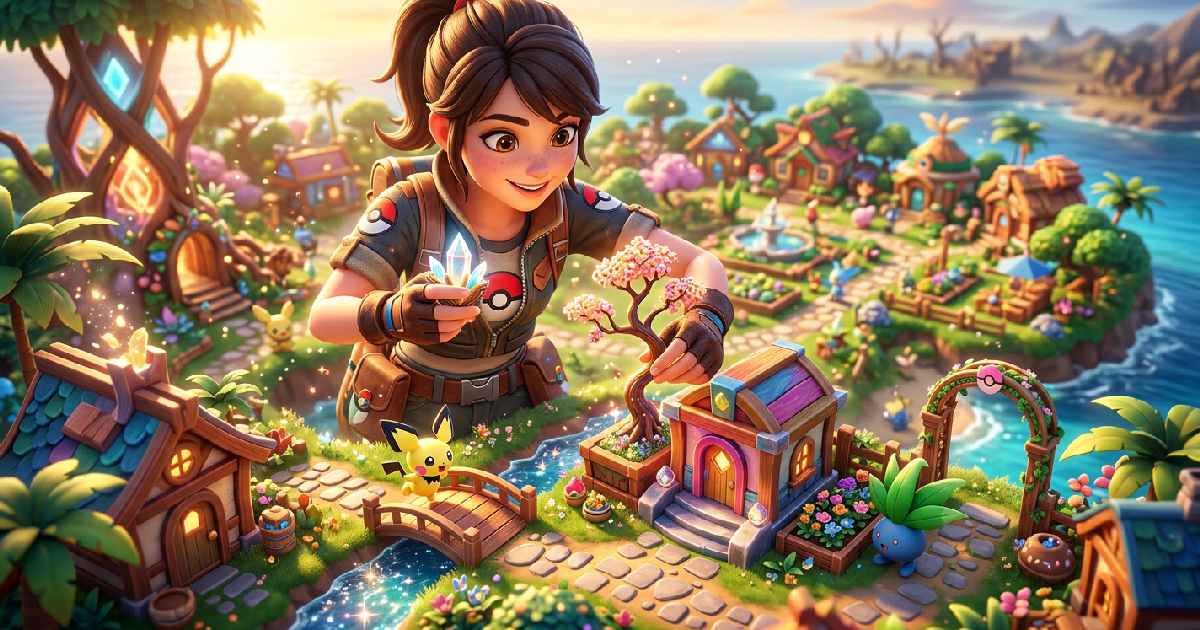
Transforming the Starter Zone through Creative Building
The core hook of Pokopia involves moving from one environment to the next to unlock new materials. However, the game’s building and housing systems have created a scenario where the desire for a perfect layout often outweighs the need for progression. Players are spending dozens of hours organizing tutorial structures into specialized districts, treating the starting area as a permanent canvas rather than a stepping stone.
For many, this has led to a thorough redesign of the Withered Wasteland. Reports from the community indicate that users are creating tailored habitats by organizing their map based on the needs of different species. This includes creating conservation areas for plant-based companions and rustic villages for terrestrial types. Much like how the Epic Games Store expanded its mobile reach to capture diverse player segments, this partnership appears to have successfully reached an audience that typically favors simulation-heavy titles.
Resource Constraints and Creative Problem Solving
One of the more interesting aspects of remaining in the first area is the self-imposed limitation on materials. The game generally rewards those who advance to new biomes with superior building blocks and decorative items. By choosing to stay behind, players are forced to work with basic wood and stone, mimicking the survival-style constraints found in other popular sandbox titles.
The psychological shift is also notable among the fan base. Long-time players accustomed to the immediate feedback of a level-up are now finding satisfaction in a slower, more deliberate gameplay loop. This approach prioritizes long-term goals, such as a finished town, over the immediate reward of unlocking a new area. It reflects a maturing audience that values the process of construction as much as the final result.
Market Shifts and the Popularity of Low-Stress Gaming
The reception of Pokopia’s simulation elements comes at a time when the gaming industry is seeing a rise in the popularity of the “cosy” genre. This isn’t just limited to software; hardware manufacturers are also observing these market pressures. For example, as Sony raises PS5 prices in certain regions, the demand for accessible and evergreen experiences on handheld platforms remains a notable factor in the industry.
Pokopia has been well-received by those who enjoy deep simulation mechanics. Reviewers have highlighted how the specific mannerisms of the creatures provide enough depth that the lack of traditional combat hasn’t deterred the core audience. For many dedicated builders, the starting zone is no longer a tutorial, but a permanent residence where they can experiment with the game’s physics and building tools without the pressure of a ticking clock or a mounting narrative.
Future Outlook for Simulation Spin-offs
The staying power of Pokopia will likely influence how future projects in the franchise are approached. While mainline entries remain the primary drivers of broad interest, the high levels of engagement seen in this sandbox experiment suggest a significant demand for non-combative experiences. As players continue to work through their complex island visions, the “endgame” for the most dedicated builders appears to be quite distant.
While some sectors of the tech and digital asset world have faced periods of uncertainty—similar to how Bitcoin fell below key levels recently—the niche for relaxed, creative gaming appears to be a stable area for developers to explore. The willingness of the player base to spend weeks in a single zone proves that depth of engagement can be just as valuable as the size of the world map. For the residents of the Withered Wasteland, the slow pace is exactly what they were looking for.