

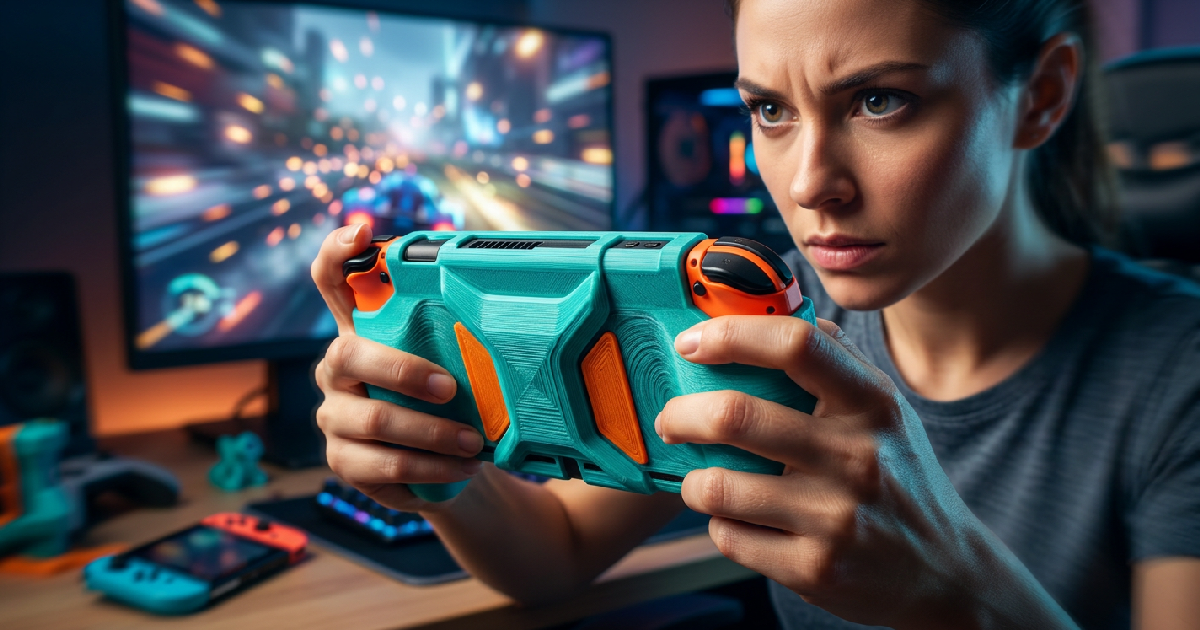
Custom Nintendo Switch 2 Accessories Explored by 3D Printing Community
The gaming community has already begun exploring ways to enhance the user experience of future hardware through home manufacturing. While Nintendo tends to keep its cards close to its chest regarding final specifications for its next-generation hardware, makers and engineers are reportedly preparing for a shift toward self-reliance. This trend involves 3D printing enthusiasts looking to bypass the usual wait for official peripherals by creating their own hardware solutions at home.
For many players, the appeal of handheld gaming lies in its modularity. However, that design often necessitates secondary accessories like grips, stands, and protective cases. Industry reports suggest that potential early adopters of new systems are likely to prioritize utility, focusing on designs that address the ergonomics of handhelds that are expected to be larger and more powerful than previous iterations. By utilizing 3D printing, players may be able to create bespoke hardware tailored to their specific needs before third-party accessories even reach traditional retail stores.
Customizing Handheld Platforms Through Home Manufacturing
One of the most practical applications for 3D printing in the gaming space involves ergonomic enhancement. Portability and comfort often exist in tension; any upcoming handheld console is expected to navigate this balance. Makers are already iterating on “comfort grips” that are designed to snap onto a console’s body, providing a more traditional controller feel without the bulk of a dedicated gamepad. These prints allow for a more natural wrist position, which can be essential for long sessions of competitive titles or immersive RPGs.
Beyond comfort, 3D printing offers unique solutions for localized multiplayer setups. Portable stands that allow a console to sit at a higher angle while charging have become a staple of the maker community. These designs frequently provide more flexibility than official versions because they can be modified early on to include extra slots for physical game cartridges or SD cards. This move toward expansion into mobile platforms and hardware customization mirrors broader trends in the industry where users want more control over their physical setup.
Protecting Next-Generation Gaming Hardware
The transition to any new hardware often brings the risk of minor damage or accidental drops. While the market for hardshell cases is vast, 3D printing allows owners to manufacture specialized protective gear like screen shields and joystick guards. These small, low-cost prints are often designed to prevent joystick wear and screen abrasions that have been noted in earlier handheld iterations. Furthermore, modular wall mounts are becoming a popular choice for gamers who want a clean, minimalist setup for their docking stations.
And it is not just about protection; it is also about organization. Many enthusiasts are designing desktop “command centers” that hold a console along with several controller pairs and accessories. Because the designs are digital, they can be scaled or tweaked to accommodate various cord thicknesses and plug types, ensuring that the charging area remains clutter-free. This level of personalization is becoming increasingly attractive as Sony raises prices again and other manufacturers face similar economic pressures, driving consumers to find value in DIY solutions.
The Intersection of Technology and Consumer Independence
The rise of high-quality, affordable 3D printers has changed how consumers interact with their electronics. Instead of waiting for a global shipping cycle to deliver a plastic stand from an overseas warehouse, a player can download a file and have a functional accessory ready in hours. This shift aligns with the general economic climate, as players look for ways to manage costs without sacrificing the quality of their gaming experience.
This “print-it-yourself” culture also acts as a creative outlet. Fans have begun designing aesthetic shells prompted by specific game franchises, allowing for a level of personalization that console manufacturers rarely offer outside of limited-edition releases. If a user wants a dock that reflects a specific game theme or a cartridge holder shaped like a power-up, they no longer need to rely on a manufacturer to see a profit motive in that specific design.
Future Outlook for the Maker Community
As the release of new gaming hardware approaches, the repository of available files on platforms like Thingiverse and Printables is expected to grow. Early prototypes often rely on leaked dimensions and CAD files, which are then refined as soon as physical units reach the hands of the public. This rapid iteration cycle is one of the more active aspects of modern gaming culture, allowing the community to respond to hardware needs faster than traditional manufacturing pipelines.
The move toward home manufacturing also highlights a growing demand for repairability and sustainability. When a part on an accessory breaks, a 3D printer owner can simply print a replacement rather than discarding the entire unit. This mindset is vital as the industry faces mounting economic pressures and a need for more efficient resource management. As we look at the coming years of the console cycle, the most practical accessories might not come from a retail shelf at all, but from a nozzle in a home workshop.