

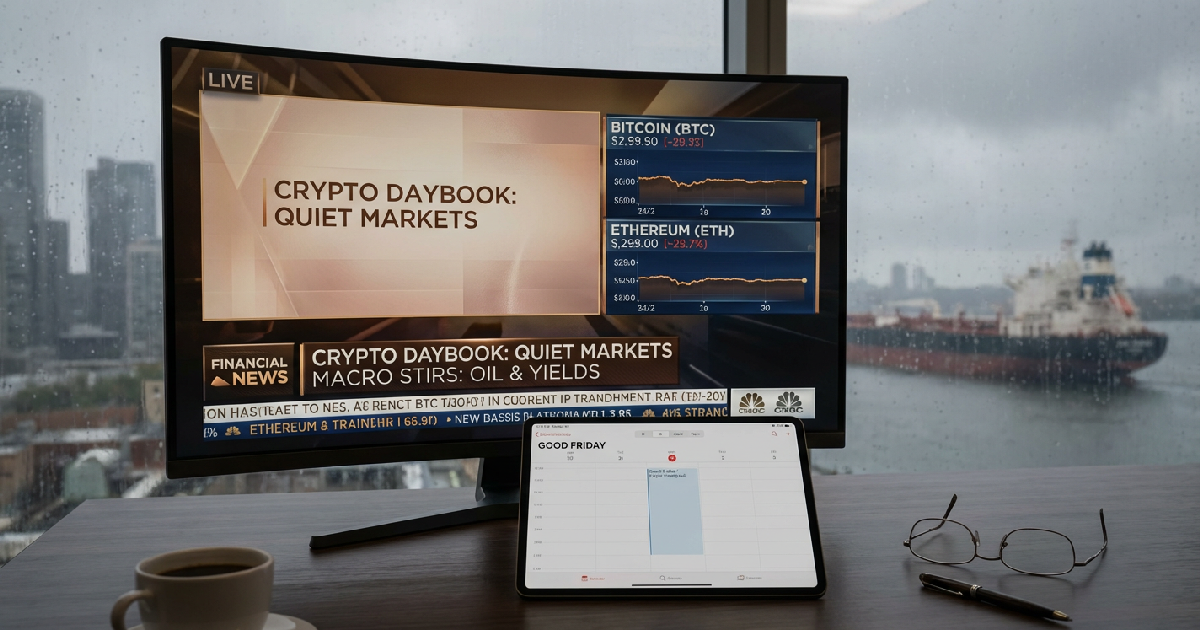
Crypto Daybook Americas notes quiet markets as macro stirs
Trade volumes across major digital asset exchanges have thinned significantly as the industry enters the Good Friday holiday period. While the crypto markets remain functional 24/7, the institutional liquidity that typically drives price action has largely retreated, leaving Bitcoin and Ethereum to move in narrow, sideways channels. This quiet spell for digital assets stands in stark contrast to the volatility currently observed in the energy and macro sectors.
Macro Winds and Crude Oil Divergence
While the Crypto Daybook for the Americas shows a sector in a holding pattern, external markets are refusing to settle. Crude oil prices have seen an uptick this morning, fueled by ongoing geopolitical tensions and supply-side concerns. Historically, such movements in the energy sector create a ripple effect through risk assets, but today, Bitcoin has decoupled from that immediate volatility.
The lack of movement in the majors—Bitcoin and Ether—suggests that traders are positioning for a more significant catalyst expected later in the month. When traditional markets close for holidays like Good Friday, crypto often experiences “thin-order-book volatility,” where even small trades can move the price disproportionately. However, so far today, that volatility has remained muted. Investors are clearly looking past the immediate holiday and toward the broader macroeconomic picture, which has been complicated by shifting interest rate expectations and persistent inflation data.
The Institutional Pause and Liquidity Gaps
Market participants should be wary of the current “snooze” phase. When the Americas session opened today, the typical surge in ETF-related inflows and spot buying was noticeably absent. This lack of institutional participation creates a vacuum. Often, these periods of low activity precede sharp, corrective moves as the market seeks to re-establish a price floor once the full force of the banking sector returns.
There is also the matter of the institutional pullback that analysts have been watching. With Morgan Stanley and other major players now deeply integrated into the Bitcoin ecosystem, their operational hours—or lack thereof during public holidays—dictate the rhythm of the market more than they did in previous cycles. For retail traders, this provides a rare moment to breathe, but it also increases the risk of being caught on the wrong side of a “whack-a-mole” price action if a sudden whale move occurs in a low-liquidity environment.
Bitcoin and the Regulatory Watch
Politics continues to play a background role even as trading slows. Geopolitical narratives often drive Bitcoin’s status as a “digital gold,” but current dynamics are more focused on domestic policy. For instance, the Clarity Act’s impact on stablecoins remains a central talking point for long-term holders who are navigating how yield-bearing assets will be treated by regulators throughout 2026.
And while the current market feels stagnant, Bitcoin is hovering at levels that have historically served as either a springboard or a precipice. Technical indicators point toward a volatility squeeze, suggesting that this period of “snoozing” is merely the calm before a storm. Whether that storm breaks to the upside or forces a deeper correction will likely depend on the macro data surfacing early next week.
For now, the Crypto Daybook reflects a market that is content to wait. With crude oil and macro indicators stirring the pot, the resilience—or stagnation—of digital assets over the next 48 hours will be a telling sign of the market’s underlying strength.
Frequently Asked Questions
Why is crypto trading volume lower on Good Friday?
While crypto markets never close, the institutional desks, hedge funds, and banking rails that facilitate large-scale trades often observe public holidays. When these “market makers” are away, the overall volume drops, often leading to slower price movements or unpredictable spikes due to lower liquidity.
How does the rising price of oil affect Bitcoin?
Usually, rising oil prices can signal inflationary pressure, which may lead the Federal Reserve to keep interest rates higher for longer. Higher interest rates are generally seen as a headwind for “risk-on” assets like Bitcoin, though sometimes BTC is viewed as a hedge against the very inflation that oil prices can cause.
Is this a good time to enter the market?
Periods of low volatility and consolidation are often viewed by long-term investors as accumulation phases. However, thin markets carry the risk of sudden “flash” moves. Many traders prefer to wait until traditional markets reopen to see where the real directional momentum lies.