

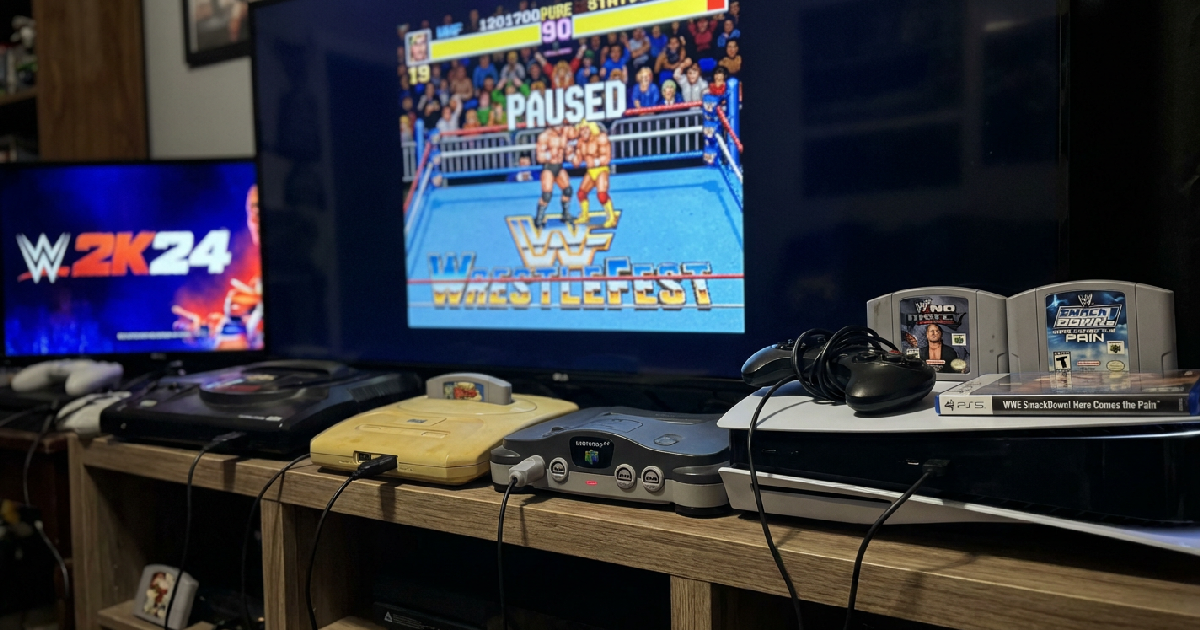
Evolution of Wrestling Video Games from WrestleFest to 2K25
The release of WWE 2K24 has reignited a perennial debate among wrestling fans: which era truly clinches the title for the best digital representation of the squared circle? As the industry looks ahead toward the potential of WWE 2K25, the evolution of the genre remains a fascinating study in technological jumps and mechanical shifts. From the vibrant, quarter-eating cabinets of the early nineties to the ultra-realistic physics engines of the current generation, wrestling games have mirrored the industry’s own stylistic changes.
Tracing the lineage logic of these titles reveals a story of two different philosophies: the accessible “pick-up-and-play” arcade style versus the deep, intricate simulation. While modern titles aim for broadcast accuracy, many veterans still point to the arcade and 64-bit eras as the high-water marks for pure fun.
The Arcade Peak of WWF WrestleFest
In 1991, Technōs Japan released WWF WrestleFest, a title that many still consider the gold standard for arcade wrestling. It wasn’t just about the sprites, which were massive and expressive for the time, but the pacing. It captured the Saturday morning cartoon energy of the Hulk Hogan and Ultimate Warrior era perfectly.
Unlike modern titles that require memorizing complex button combinations, WrestleFest relied on a simple “strike and grapple” mechanic that anyone could understand within thirty seconds. The inclusion of the Royal Rumble mode and the iconic “Legion of Doom” as the ultimate gatekeepers provided a level of challenge that defined the arcade experience of the decade. It remains a masterclass in how to prioritize personality over complex simulation.
The AKI Era and the Nintendo 64 Revolution
If you ask a wrestling gamer of a certain age about the “best” game, the conversation usually starts and ends with the AKI Corporation titles on the Nintendo 64. Games like WCW/nWo Revenge and WWF No Mercy introduced a grapple system that changed the genre forever. It was a weight-based system: you couldn’t just suplex a giant until you had worn them down.
The depth of the “Create-a-Wrestler” suite in No Mercy, combined with a branching season mode that reacted to wins and losses, set a benchmark that developers are still trying to recapture. Even now, in 2026, the modding community for these 25-year-old games remains remarkably active, proving that the foundation of those mechanics was near-perfect.
Evaluating the Simulation Shift in WWE 2K24 and Beyond
The current landscape is dominated by Visual Concepts and the 2K franchise. Following the disastrous launch of 2K20 years ago, the series has undergone a significant rebuilding phase. WWE 2K24 represents the most polished version of the “modern” style, blending high-fidelity graphics with a gameplay loop that feels more like a TV broadcast than a traditional game.
And yet, the anticipation for WWE 2K25 suggests fans are looking for even more. The focus has shifted toward “MyFaction” and “Universe Mode”—systems designed to give players control over the entire promotion, rather than just the action in the ring. While these games lack the immediate, visceral simplicity of WrestleFest, they offer a level of creative freedom that was unthinkable in the 90s.
The Middle Ground of SmackDown Here Comes the Pain
No discussion of this lineage is complete without mentioning the PlayStation 2 era, specifically SmackDown! Here Comes the Pain. This title is often cited as the perfect middle ground. It had the speed and “over-the-top” physics of an arcade game, such as jumping off the fist of the SmackDown set, but it also introduced a sophisticated damage system and a sprawling season mode.
It was an era where the rosters were arguably at their peak, featuring icons like The Rock, Stone Cold Steve Austin, and a rising Brock Lesnar. The game felt dangerous and fast, a stark contrast to the more methodical movements we see in today’s simulations.
What Lies Ahead for the Genre
As we move toward the next hardware cycles and the eventual announcement of WWE 2K25, the industry seems to be at a crossroads. There is a clear appetite for “retro” revivals—evidenced by the interest in titles like All Elite Wrestling’s attempt to recapture the No Mercy feel—but the mainstream audience demands the 4K resolution and photorealistic textures that only 2K currently provides.
The future likely involves a greater integration of live-service elements, but for many, the heart of the genre will always be found in those local multiplayer sessions, whether it was on a fuzzy CRT monitor in 1991 or a high-end console today.
Frequently Asked Questions
Why is WWF No Mercy still considered so good?
It comes down to the “easy to learn, hard to master” grapple system. The timing-based reversals felt fair, and the physical weight of the characters influenced how the matches flowed, making it feel more like a real struggle than a pre-scripted dance.
How does WWE 2K24 compare to the older arcade games?
They are fundamentally different experiences. 2K24 is a simulation designed to look like a television product. Older arcade games like WrestleFest were designed for quick sessions and immediate gratification. 2K24 requires much more time to learn the defensive mechanics.
Will WWE 2K25 return to an arcade style?
It is unlikely that the main 2K series will pivot away from simulation, as that is their primary selling point. However, the developers often add “arcade” sliders or modifiers to allow fans to speed up the gameplay to mimic that classic feel.