

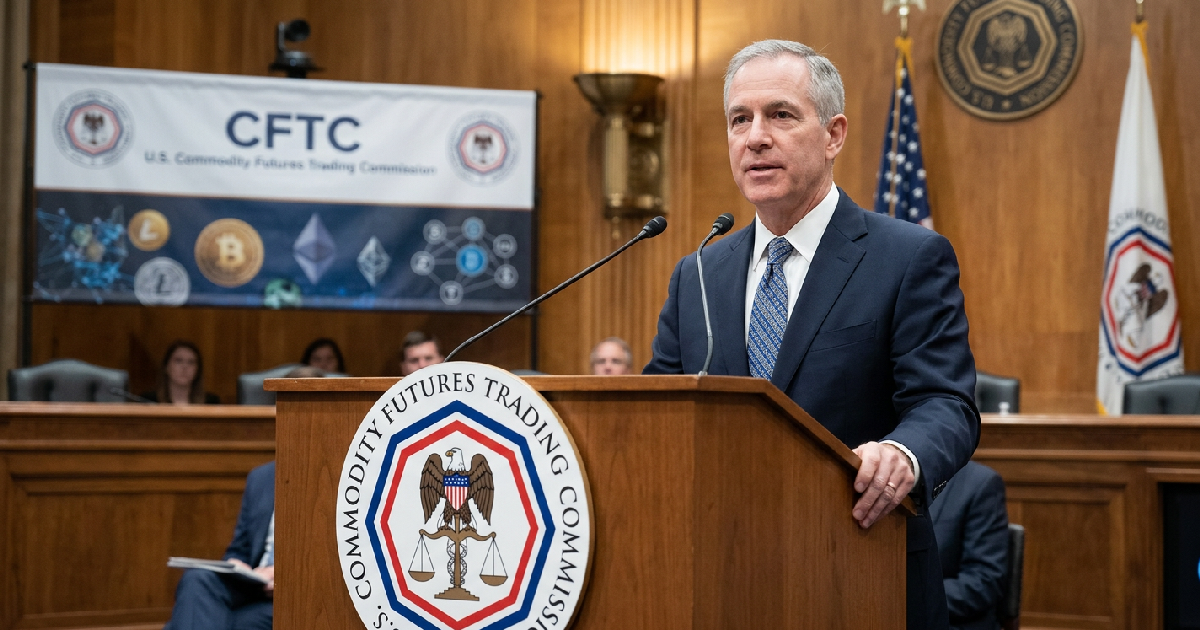
CFTC Michael Gillick says agency ready for total crypto oversight
The long-standing jurisdictional friction between U.S. financial regulators took a sharp turn today as the Commodity Futures Trading Commission (CFTC) made its most expansive bid for authority yet. Marking his first 100 days in office, Chairman Michael Gillick told reporters that the agency is fully prepared to take the reins of the entire cryptocurrency market, asserting that the CFTC is the natural home for digital asset oversight.
Gillick’s statement moves beyond the previous “regulation by enforcement” approach that has characterized the American crypto sector over the last few years. By positioning the CFTC as the primary supervisor, he is effectively challenging the current status quo where various agencies—most notably the SEC—have claimed overlapping jurisdiction over different facets of the industry. The Chairman’s confidence suggests a shift in the political winds as Washington grapples with how to formalize a framework for the $2 trillion asset class.
Expanding the CFTC reach beyond commodities
For years, the debate over crypto regulation has centered on whether assets like Bitcoin and Ether are securities or commodities. While Bitcoin is widely accepted as a commodity, the status of newer tokens remains a legal minefield. Gillick, however, appears ready to bypass these granular debates. His comments indicate that the CFTC is not just looking to manage futures and derivatives, but the underlying spot markets and the infrastructure that supports them.
The timing of these remarks is particularly poignant given the current legislative climate. As the [digital asset industry faces a final test for global utility](/crypto-industry-utility-deadline-2026-analysis), the lack of a clear “cop on the beat” has been cited by institutional investors as a primary reason for hesitation. Gillick argues that centering this power within the CFTC would provide the market clarity that has been sorely lacking, potentially ending the era of conflicting mandates.
But expanding the agency’s footprint isn’t just about administrative comfort. It requires a massive scaling of resources. The CFTC has historically operated with a smaller budget than the SEC, and taking on the entire crypto market would necessitate a significant infusion of capital and personnel to handle the 24/7 nature of digital finance.
Michael Gillick claims sole authority over prediction markets
A specific point of emphasis in Gillick’s 100-day address was the contentious world of prediction markets. These platforms, which allow users to bet on real-world outcomes ranging from election results to economic data, have surged in popularity over the last year. Gillick was blunt about who owns this space: the CFTC is the sole regulatory body with the authority to supervise these markets.
This stance is likely to ruffle feathers at the state level and among other federal agencies who view prediction markets as a form of gambling rather than financial hedging. By claiming exclusive jurisdiction, Gillick is attempting to standardize how these platforms operate, likely bringing them under the same rigorous reporting and consumer protection standards as traditional futures markets.
And it is not just about oversight; it’s about legitimacy. If prediction markets are officially categorized as CFTC-regulated instruments, it would effectively mainstream them, allowing institutional participation and potentially massive increases in liquidity. However, this also means the “wild west” era of decentralized, offshore prediction platforms could be coming to a swift end.
The impact on market participants and exchanges
For exchanges and developers, the prospect of a single, definitive regulator is a double-edged sword. On one hand, dealing with one set of rules is infinitely preferable to being caught between the SEC and CFTC. On the other hand, the CFTC’s oversight brings its own set of burdens, including strict anti-money laundering (AML) and know-your-customer (KYC) requirements that many decentralized protocols are currently ill-equipped to handle.
The industry response has been cautiously optimistic. Many leaders have long argued that the CFTC’s principles-based approach is a better fit for the fast-evolving crypto market than the SEC’s more rigid disclosure-based framework. If Gillick can deliver on this promise, it might finally provide the regulatory “green light” needed to unlock more stable growth in the sector, especially as [Bitcoin edges higher](/geopolitics-bitcoin-ethereum-iran-conflict-impact-2026) amidst broader macroeconomic uncertainty.
What the 100-day milestone signals for 2026
Gillick’s first 100 days have been defined by a clear desire for territory. The Chairman has spent less time discussing the “whether” of regulation and more on the “who.” By asserting dominance now, the CFTC is setting the stage for upcoming legislative sessions where Congress is expected to vote on several key stablecoin and market structure bills.
The roadmap for the remainder of 2026 seems clear: the CFTC will push for a “spot market” oversight bill that codifies Gillick’s vision. If successful, this could represent the most significant shift in U.S. financial policy since the Dodd-Frank Act. For now, the crypto market remains in a state of watchful waiting, seeing if Gillick’s bravado can survive the inevitable pushback from Capitol Hill and rival regulatory bodies.
Frequently Asked Questions
Is the CFTC now the only crypto regulator in the US?
Not yet. While Chairman Gillick has stated the agency is prepared to oversee the entire market, current law still grants the SEC authority over assets deemed securities. Gillick’s comments are a signal of intent and a call for Congress to formalize the CFTC’s role as the primary supervisor.
How will this affect existing crypto prediction markets?
If the CFTC cements its role as the sole supervisor of prediction markets, platforms will likely need to register as designated contract markets (DCMs). This would mean stricter rules regarding who can trade and what events can be bet on, likely leading to more “sanitized” and legally compliant platforms.
What is the difference between CFTC and SEC regulation for crypto?
Generally, the CFTC’s approach is considered “principles-based,” focusing on market integrity and preventing manipulation in commodities. The SEC follows a “disclosure-based” model designed for securities, requiring far more rigorous and expensive registration processes for issuers. Most in the crypto industry prefer the CFTC model for its perceived flexibility.