

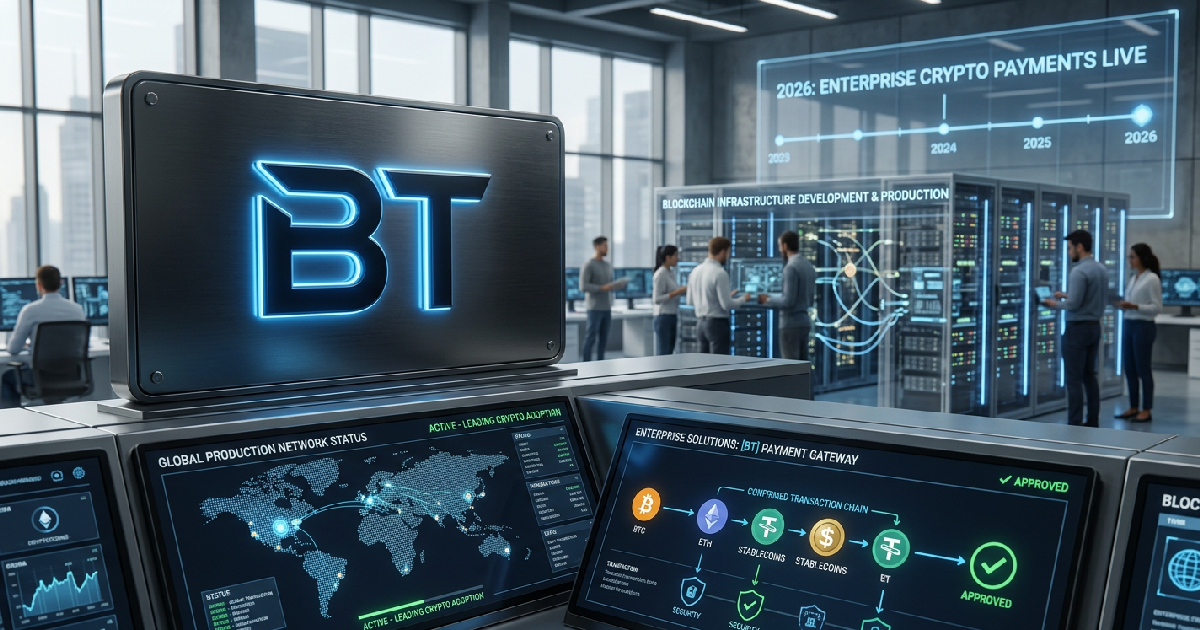
Black Titan Details Shift to Production Crypto Payments
The bridge between conceptual blockchain technology and enterprise-grade financial systems is narrowing. This week, Black Titan has shifted the conversation toward the practical realities of crypto payment infrastructure, signaling a move into what the industry calls “production-level” readiness. For years, the digital asset space has been plagued by experimental “beta” phases and proof-of-concepts that struggled to handle the rigors of high-volume commercial traffic. That era appears to be ending.
Recent developments suggest that the focus is no longer just on token prices or speculative trading. Instead, the narrative has pivoted to how these networks function under the stress of real-world retail and institutional transactions. Black Titan’s latest insights emphasize that for cryptocurrency to move beyond its niche origins, the underlying architecture must mirror the reliability of traditional systems like Swift or Visa, but with the added benefits of decentralization and instant settlement.
The Shift to Production Ready Infrastructure
Transitioning to a production-level environment means more than just faster transaction speeds. It requires a fundamental overhaul of how data is processed, how security is managed, and how user interfaces interact with complex smart contracts. Black Titan highlights that the current “utility” phase of the market is forcing developers to prioritize stability over novelty. We are seeing a move away from the “move fast and break things” ethos that defined the early DeFi years.
This maturation coincides with a tighter regulatory environment. Recent legislative moves, such as the New Clarity Act, have started to define the boundaries for stablecoin usage and interest payments. By removing the “get rich quick” incentives from liquid assets, the market is being pushed to compete on the merit of its technology rather than the size of its yields. Black Titan’s focus on infrastructure suggests that the winners of the next cycle will be those who provide the plumbing for the global economy, not just the speculative assets.
Gaming and the Integration of Real-Time Payments
The gaming industry is becoming the primary testing ground for these production-level payment systems. Traditional microtransactions are often hampered by high fees from app stores and payment processors. Production-ready crypto rails offer a workaround, allowing developers to integrate near-instant payments for in-game assets and services with minimal overhead.
But the stakes are high. If a payment system fails in a high-stakes competitive gaming environment, it doesn’t just lose money; it loses player trust. Black Titan notes that the integration of blockchain into gaming must be invisible. The average player shouldn’t know they are interacting with a distributed ledger; they should only notice that their transactions are faster and cheaper. This “invisible” infrastructure is the hallmark of a system that has finally reached production maturity.
The Challenge of Latency and Throughput
One of the persistent hurdles for crypto payments has been latency. In a retail or gaming setting, a thirty-second wait for a confirmation is unacceptable. The move toward production-level infrastructure involves the implementation of Layer 2 scaling solutions and sidechains that can handle thousands of transactions per second without compromising the security of the main chain.
And while the technology is catching up, the industry still faces a final test for global utility. Black Titan suggests that 2026 will be the year where we see if these systems can survive a sustained “stress test” from mainstream adoption. It’s no longer enough to work in a sandbox; these systems must now perform in the wild where the financial consequences of a bug are catastrophic.
A Competitive Edge in Digital Commerce
For businesses looking to integrate these systems, the benefits are becoming too significant to ignore. Production-ready infrastructure allows for programmable money, where payments are only released when specific conditions are met, such as the delivery of a digital good or the completion of a service. This level of automation reduces the need for intermediaries and lowers the risk of fraud.
Black Titan’s analysis points to a future where the distinction between “crypto” and “finance” begins to blur. As these payment structures become more robust, they will likely be absorbed into the backends of major retail platforms. We are seeing the infrastructure catch up to the vision, turning what was once a volatile experiment into a legitimate pillar of modern commerce.
Frequently Asked Questions
What does “production-level” mean for crypto?
It refers to a state where the technology is stable, secure, and scalable enough to be used by large-scale enterprises and millions of daily users without the frequent glitches or high costs associated with early-stage blockchain projects.
How does this affect the average gamer or shopper?
The goal is for the user experience to be seamless. You likely won’t even realize you’re using crypto; you’ll just experience lower fees, faster checkout times, and more control over your digital assets and in-game purchases.
Is the technology ready for global use right now?
While the infrastructure is reaching production standards, widespread adoption still faces hurdles, including regional regulations and the need for better user interfaces. Black Titan and other industry leaders suggest we are currently in the critical transition phase between testing and full integration.