

Slay the Spire 2 Co-Op Mode Emerges as Early Game of the Year Contender
Slay the Spire 2 is reshaping expectations for roguelike deckbuilders as its newly introduced cooperative mode begins drawing attention across the gaming community. Early hands-on impressions suggest the four-player multiplayer feature could elevate the sequel from a niche strategy title into one of the year’s most talked-about releases. By layering coordinated combat, shared encounters, and inventive player interaction on top of the original’s deck-building framework, developer Mega Crit appears to have created a fundamentally new way to experience the genre.
Cooperative Design Reinvents the Roguelike Deckbuilder
At the center of Slay the Spire 2’s early buzz is a feature rarely associated with the genre: multiplayer cooperation.
The game allows two to four players to participate in the same roguelike run, confronting enemies, events, and map decisions together. Unlike traditional co-op RPGs where each player controls a distinct character, the system initially creates confusion—everyone begins with the same base character, deck archetype, and relic pool.
However, the gameplay loop quickly reveals a nuanced structure. While players participate simultaneously in combat and events, each individual retains their own cards, potions, gold, and upgrades. The team shares the map path and enemy modifiers but develops unique builds within that framework.
This design effectively transforms the strategic foundation of the original Slay the Spire. Instead of optimizing a single deck, players must now consider how their cards and relics interact with teammates’ builds, introducing layers of synergy rarely seen in roguelike deckbuilders.
Tactical Coordination Becomes Central
Combat unfolds simultaneously across the group, encouraging constant communication.
For example:
- One player might apply Vulnerable to enemies to amplify teammates’ attacks.
- Another may build around poison stacks, enabling allies to gain defensive bonuses tied to poison effects.
- A defensive player could redirect enemy damage toward themselves, allowing a teammate to commit fully to offense.
These interactions shift the gameplay from individual optimization to team-oriented strategy, closer to cooperative tabletop games than traditional single-player roguelikes.
Small Design Details Elevate the Multiplayer Experience
Beyond the core mechanics, several subtle interface decisions shape the cooperative experience.
Visual Communication Between Players
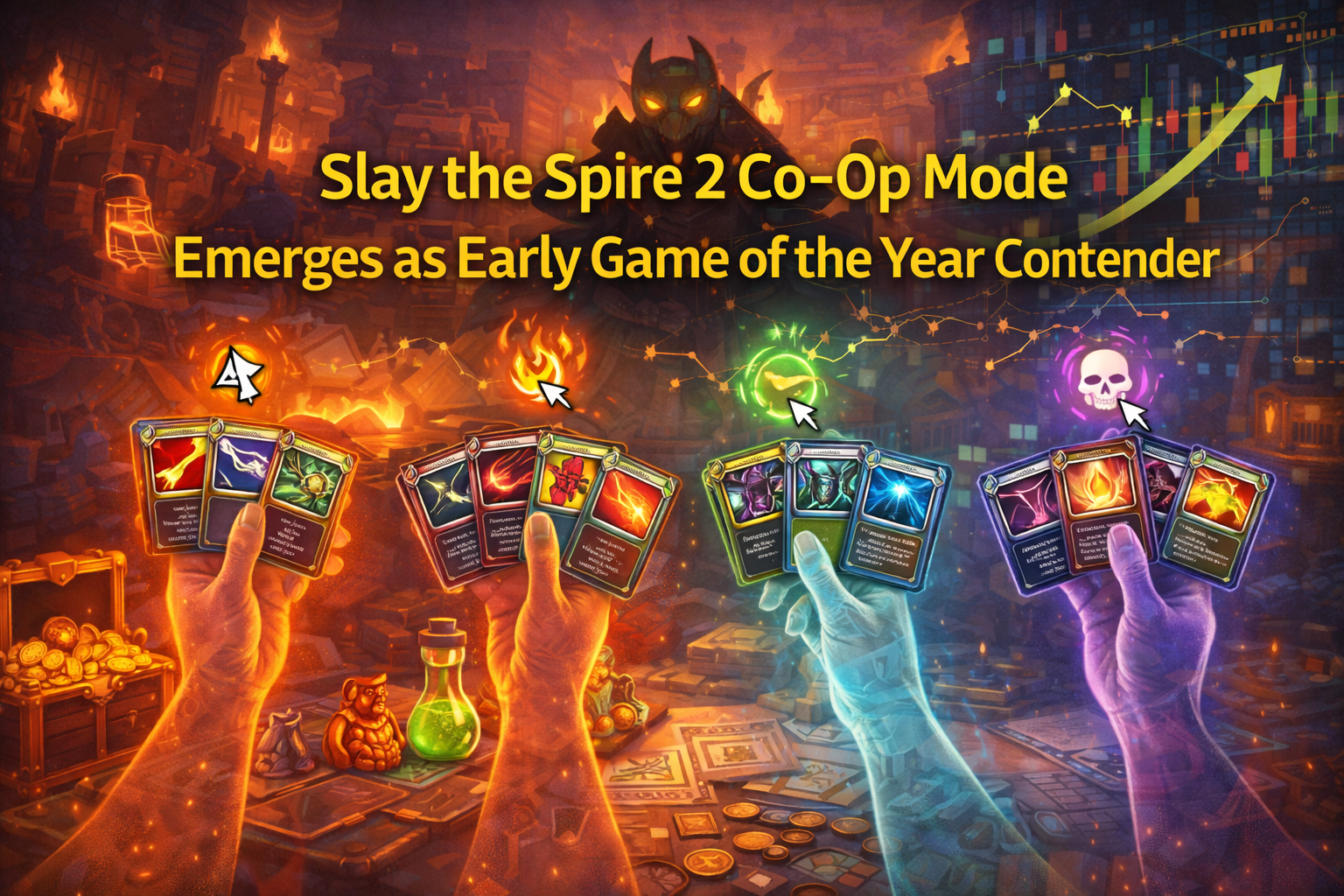
Each participant appears on screen as a semi-transparent hand representing their cursor, allowing teammates to see what others are examining or considering in real time.
Players can also click on allies to inspect:
- Their card hand
- Current relics
- Resource pools
While voice chat remains useful for coordination, these visual cues provide enough context for players to understand team strategy without constant verbal communication.
Shared Map Interaction
Slay the Spire’s branching map structure—long a staple of the series—becomes a collaborative element in co-op mode.
Players vote on which route to take through the map. Once everyone has chosen a path, a roulette-style selection system randomly determines the final route, ensuring that each player’s input influences the decision.
To ease pacing conflicts between faster and slower players, Mega Crit introduced an unexpected solution: teammates waiting for others to finish planning can draw directly on the map. These drawings persist throughout the act, creating a playful layer of social interaction while players plan their next move.
Cooperative Relic Selection Introduces Competitive Humor
Loot distribution—often a friction point in multiplayer games—receives an unusual treatment.
When players encounter a chest containing relics, everyone can hover over their preferred item. If multiple players select the same relic, the game resolves the conflict through an automated rock-paper-scissors duel between the participants.
The mechanic turns potential disputes into a lighthearted moment, reinforcing the game’s board-game-like atmosphere.
Flexibility for Adult Gaming Schedules
Another practical feature addresses a common challenge in multiplayer games: coordinating schedules.
Runs in Slay the Spire 2 can last several hours, but the game allows the host to save multiplayer sessions mid-run. Players can resume the exact session later with the same group while still participating in other runs separately.
For cooperative games aimed at strategy-focused audiences—many of whom balance gaming with work and family commitments—this flexibility significantly improves accessibility.
Familiar Foundations With a New Layer of Depth
The sequel still carries much of the DNA that made the original Slay the Spire a defining roguelike deckbuilder. Early character archetypes, card mechanics, and relic systems remain recognizable.
Yet the addition of cooperative play dramatically alters how those systems interact.
Where the first game centered on mastering probability, deck composition, and relic combinations individually, the sequel pushes players toward collective strategy, role specialization, and coordinated card timing.
Even in its early access phase, the design demonstrates how a familiar formula can evolve without discarding its core identity.
Early Reception Signals Strong GOTY Potential
While additional balancing and content updates are likely as development continues, early impressions from players and reviewers highlight the cooperative mode as a standout innovation.
The roguelike deckbuilder genre has expanded significantly in recent years with titles such as Monster Train introducing new twists to the formula. Slay the Spire 2’s multiplayer approach now pushes the genre in a different direction—toward social strategy experiences built around shared runs.
If the cooperative systems continue to expand through additional characters, relic interactions, and card synergies, Slay the Spire 2 may emerge not only as a worthy sequel but as one of the most influential strategy games released this year.