

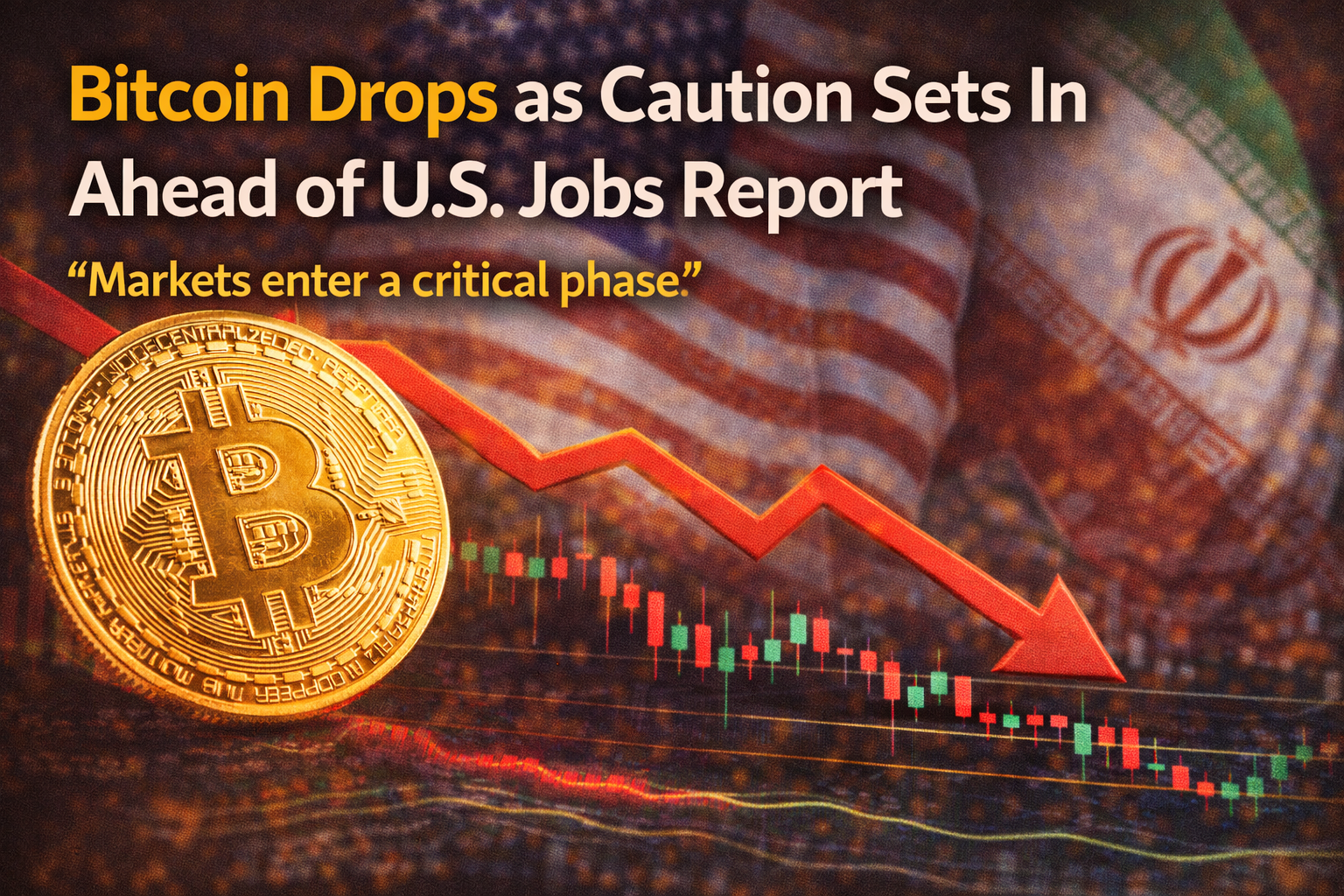
Bitcoin Slips as Traders Turn Cautious Ahead of U.S. Jobs Report
Bitcoin’s latest rally lost momentum as traders shifted into defensive positions ahead of a key U.S. employment report and rising geopolitical tensions in the Middle East. The world’s largest cryptocurrency slipped back toward the $70,000 level after briefly climbing above $74,000 earlier in the week, highlighting the fragile balance between institutional accumulation and short-term speculative selling.
Profit-taking halts Bitcoin’s midweek surge
Bitcoin fell roughly 3.7% over the past 24 hours, hovering just above $70,000 after touching $74,000 earlier in the week. The broader crypto market followed suit, with the CoinDesk 20 index declining around 3.5%.
According to analysts, the pullback reflects traders locking in gains after the recent rebound rather than a structural shift in market sentiment.
Illia Otychenko, lead analyst at CEX.IO, noted that confidence behind the rally remains limited.
“Despite the recent recovery, there is still limited conviction that the rally will continue,” Otychenko said, pointing to short-term traders who entered positions during the bounce and are now exiting.
Derivatives markets show rising bearish sentiment
Crypto derivatives data reveals growing pessimism among leveraged traders.
Funding rates across major exchanges remain deeply negative, indicating that traders are paying to maintain short positions betting on further price declines.
However, the derivatives market tells only part of the story. Otychenko pointed out that underlying demand signals remain intact.
Stablecoin transfers into exchanges recently reached their highest levels of 2026, suggesting investors are preparing capital for potential purchases.
Meanwhile, spot Bitcoin ETF flows have turned positive again after several days of outflows.
Spot demand and short positioning create tension
The current market structure reflects a classic divide between institutional accumulation and speculative positioning.
“Spot buyers are accumulating Bitcoin while derivatives traders are increasing short exposure,” Otychenko explained. “Historically, when that combination appears alongside negative funding rates, the market can experience a short squeeze.”
A short squeeze occurs when falling short positions force traders to buy back Bitcoin to close positions, driving prices higher.
Still, analysts caution that such a scenario is far from guaranteed.
Geopolitical risks ripple across crypto markets
Macroeconomic pressures are also shaping investor behavior.
Oil prices surged more than 22% over the past week following U.S. and Israeli strikes on Iran and retaliatory attacks that disrupted shipping routes through the Strait of Hormuz.
The chokepoint accounts for roughly 20% of global oil supply, making disruptions there a major inflation risk.
Bryan Tan, a trader at Wintermute, warned that energy market volatility could ripple into broader financial markets.
“Goldman Sachs is already warning oil could approach $100,” Tan wrote in a note, adding that bond markets are repricing inflation expectations.
U.S. jobs data becomes the next catalyst
Attention now turns to the U.S. nonfarm payrolls report, a key indicator that could influence the Federal Reserve’s interest-rate outlook.
Economists expect February job growth of around 59,000, down from the previous reading of 130,000, while the unemployment rate is forecast to remain at 4.3%.
Stronger-than-expected labor data could reinforce inflation concerns and delay potential rate cuts—conditions that typically weigh on risk assets including cryptocurrencies.
Markets enter a critical short-term phase
Bitcoin remains up more than 6% over the past five days despite the latest pullback, indicating that longer-term bullish momentum has not fully evaporated.
Still, the combination of geopolitical tensions, macroeconomic uncertainty, and short-term profit-taking has pushed markets into a cautious holding pattern.
If institutional buying continues while derivatives traders remain heavily short, Bitcoin could face sharp volatility in either direction in the days ahead.
For now, traders appear content to wait for the next macro signal before committing to a clearer trend.
Source:CoinDesk