

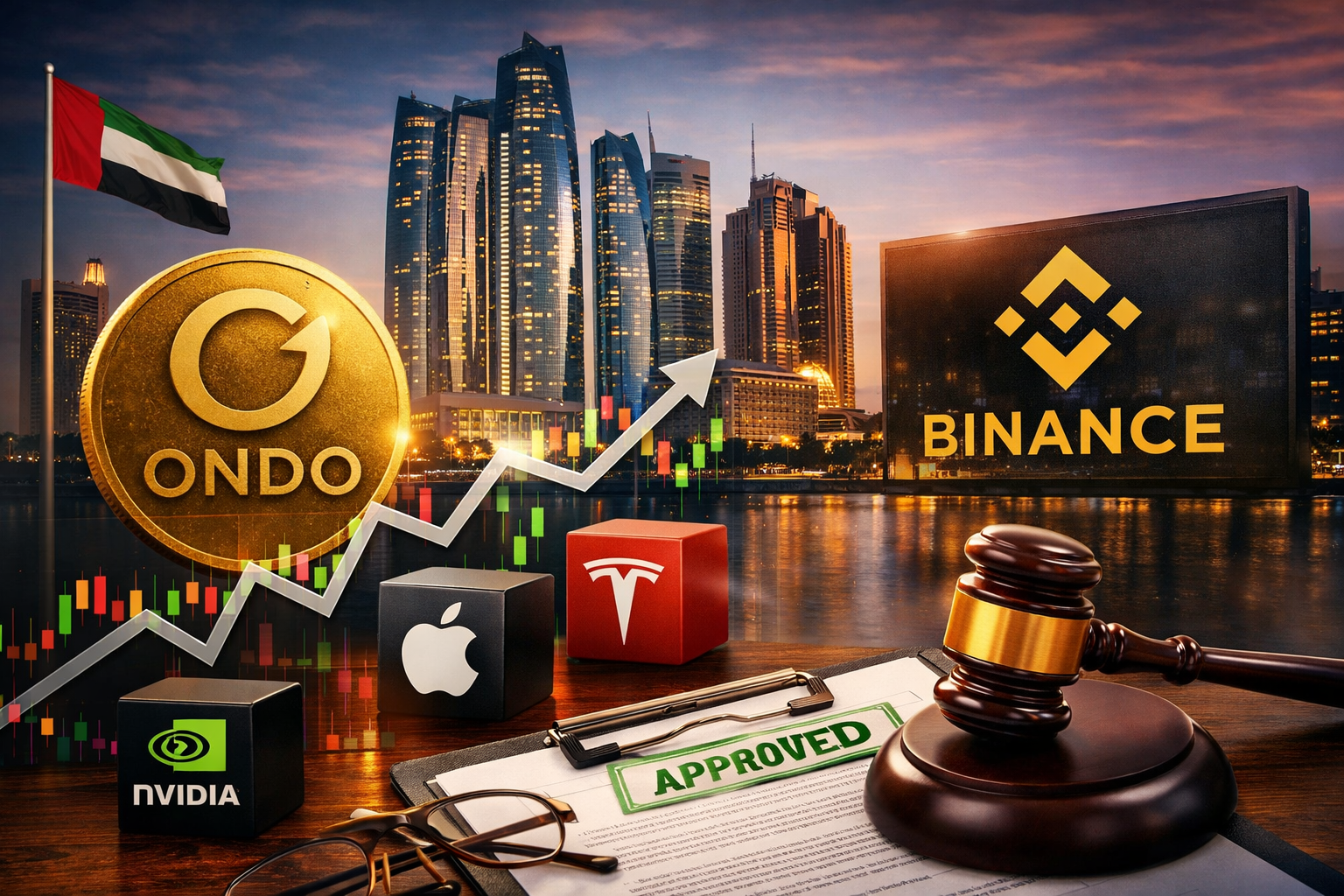
Ondo’s Tokenized Stocks Gain ADGM Approval on Binance
Abu Dhabi’s financial regulator has authorized trading of Ondo Finance’s tokenized equities and ETFs on Binance’s regulated platform, marking the first time the Abu Dhabi Global Market has approved tokenized securities under its framework. The decision provides a regulated pathway for blockchain-based equity exposure in the UAE and reopens a market segment Binance exited under regulatory scrutiny nearly five years ago.
The Financial Services Regulatory Authority (FSRA) of the Abu Dhabi Global Market (ADGM) cleared Ondo Global Markets’ digital equity products for trading on Binance’s FSRA-regulated Multilateral Trading Facility. The listing includes tokenized exposure to major U.S. stocks and the Invesco QQQ ETF and is available to non-U.S. investors.
Regulatory Milestone for Tokenized Securities in Abu Dhabi
The approval marks a structural shift rather than a routine product listing. ADGM’s framework had not previously permitted tokenized securities trading in this format. With the clearance, UAE-based financial institutions, intermediaries and counterparties can transact in blockchain-based representations of publicly listed equities under a regulated environment.
Industry executives described the development as a step toward mainstream financial integration.
“Through offering Ondo tokenized stocks for trading on Binance, we are expanding access to hundreds of millions of investors,” Ian de Bode, president of Ondo Finance, said in a statement.
The authorization positions Abu Dhabi among a limited group of jurisdictions moving beyond pilot programs to enable regulated secondary trading of tokenized traditional assets.
Binance Re-Establishes a Regulated Tokenized Stock Venue
For Binance, the approval carries strategic implications.
The exchange previously launched tokenized stock offerings in 2021 but discontinued the service after facing scrutiny from U.K. and German regulators. The ADGM decision now provides a compliant venue for similar products, operating under FSRA oversight rather than within Binance’s higher-risk experimental platforms.
Market observers note that the move strengthens Binance’s regulatory positioning as it seeks to rebuild trust and expand institutional services.
Product Structure and Market Footprint
Ondo structures its tokenized equities as equity-linked notes tied to underlying shares rather than direct on-chain custody of the stocks. The structure allows investors to gain economic exposure while aligning with securities regulations.
The approved lineup includes tokenized versions of major U.S. companies such as Amazon, Apple, Microsoft, Nvidia and Tesla, alongside the Invesco QQQ ETF. Access remains restricted to non-U.S. users.
According to company disclosures, Ondo has processed more than $11 billion in cumulative trading volume and holds over $600 million in total value locked within six months of launching its tokenized stock offerings. Data from RWA.xyz shows the broader tokenized equities market has surpassed $1 billion in total value.
Competitive Positioning in the Global Tokenization Race
The UAE has steadily advanced its virtual asset regulatory framework, aiming to combine institutional-grade oversight with digital asset innovation. By approving tokenized equity trading, ADGM signals readiness to integrate blockchain-based instruments into regulated capital markets infrastructure.
Other financial centers—including Singapore, Hong Kong and parts of the European Union—are exploring similar frameworks. Ondo last year secured approval for its base securities prospectus in the EU, allowing public distribution across the bloc. The Abu Dhabi clearance adds a Middle Eastern regulatory foothold to its expansion strategy.
Supporters of tokenized stocks argue that blockchain rails can enable faster settlement, programmable compliance and broader global access. Critics highlight liquidity constraints and jurisdictional fragmentation as ongoing challenges.
Whether tokenized equities evolve into a core component of capital markets will depend on regulatory harmonization, institutional participation and sustained secondary market liquidity.
Source: CoinDesk