

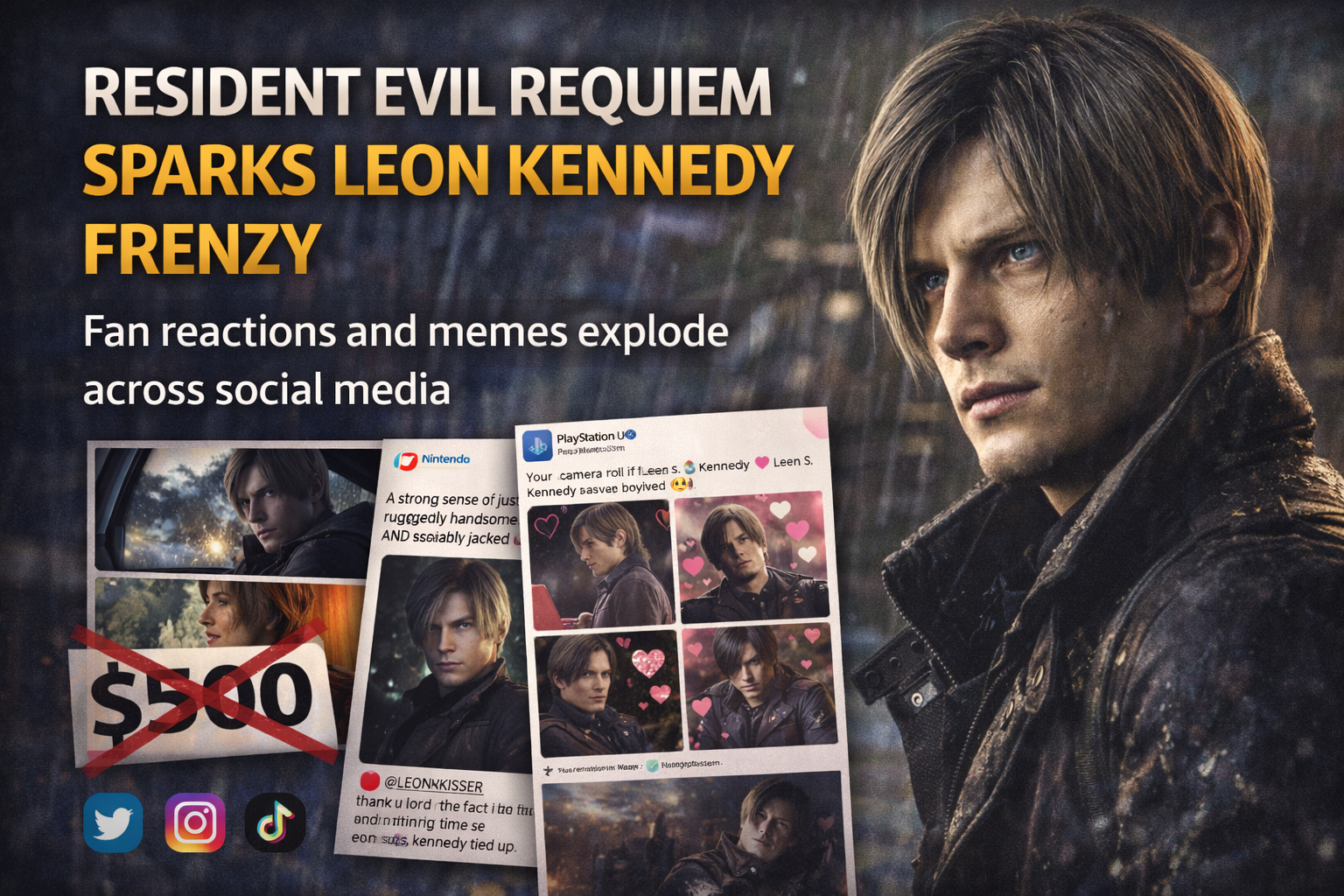
Resident Evil Requiem Sparks Leon Kennedy Frenzy
Capcom’s latest installment, Resident Evil Requiem, has reignited more than survival horror nostalgia. It has unleashed a wave of viral fan obsession centered squarely on Leon S. Kennedy.
The longtime franchise protagonist, absent from a mainline entry since 2012’s Resident Evil 6 (excluding remakes), returns older and visibly reimagined. Within hours of launch, social feeds filled with fan art, edited screenshots, and a surge of character-driven commentary that quickly outpaced broader gameplay discussion.
For Capcom, the moment underscores how character equity can rival mechanics and plot in shaping a modern game’s cultural footprint.
A Franchise Icon Returns to the Spotlight
Leon first debuted in 1998’s Resident Evil 2 and has since become one of the franchise’s most recognizable figures. In Resident Evil Requiem, he appears with a refined design that leans into maturity—weathered features, sharper facial structure, and a more grounded wardrobe aesthetic.
The redesign struck a chord.
Fans across X, TikTok, and Instagram rapidly circulated stills of Leon gazing through rain-streaked car windows and mid-combat poses. Within days, hashtags related to his name began trending in multiple regions.
The reaction wasn’t limited to grassroots fandom.
Brands Lean Into the Moment
Even official platform accounts joined the conversation. Nintendo’s social media team posted commentary praising Leon’s “strong sense of justice” and physical presence, while PlayStation UK shared Valentine’s-themed graphics imagining Leon as a hypothetical romantic lead.
The tone remained playful but pointed: platform holders recognized a viral opportunity and amplified it.
For publishers, this type of engagement represents organic marketing at scale. Rather than paid ad impressions, the game benefited from meme velocity and character-centric virality.
Character Design as Strategic Leverage
In contemporary AAA development, character modeling carries financial weight. Photorealistic rendering, motion capture refinement, and cinematic framing increasingly shape audience attachment.
Leon’s return demonstrates how a legacy character, once anchored in late-1990s survival horror, can be repositioned as a social-media-era icon.
Capcom’s investment in visual fidelity—especially facial animation and environmental lighting—contributed to the online fixation. High-resolution close-ups translate well into short-form content, where single frames can become shareable artifacts.
The response suggests that modern horror titles compete not only on tension and gameplay loops, but on the charisma and screen presence of their leads.
The Viral Economy of “Thirst”
The intensity of fan reactions reflects a broader pattern in gaming culture. Characters such as Cloud Strife (Final Fantasy), Geralt of Rivia (The Witcher), and Arthur Morgan (Red Dead Redemption 2) have experienced similar waves of viral admiration.
These moments often blend irony, sincerity, and meme culture.
For developers, the upside is measurable. Viral character moments can:
- Extend the conversation window beyond launch week
- Drive repeat engagement on streaming platforms
- Boost merchandise and crossover appeal
- Increase replayability through character-driven interest
When discourse shifts from mechanics to persona, the game occupies a wider cultural lane.
Availability and Market Positioning
Resident Evil Requiem launched across Nintendo Switch 2, PlayStation 5, Windows PC, and Xbox Series X, ensuring broad access across core console demographics.
The franchise has historically performed strongest in Japan, North America, and Europe, but the social reaction to Leon indicates potential traction in markets where character-driven fandom drives purchasing behavior.
Capcom has not released immediate sales figures, but digital engagement metrics suggest strong opening visibility.
What This Means for the Franchise
Leon’s reintroduction after more than a decade in mainline continuity signals a deliberate recalibration of the brand. Capcom appears to be balancing nostalgia with aesthetic modernization, tapping into long-term fans while attracting new audiences through character magnetism.
The broader lesson is clear: in an era dominated by short-form platforms and meme amplification, a well-designed protagonist can become as commercially valuable as any gameplay innovation.
Source: Polygon reporting and official platform social media posts.