

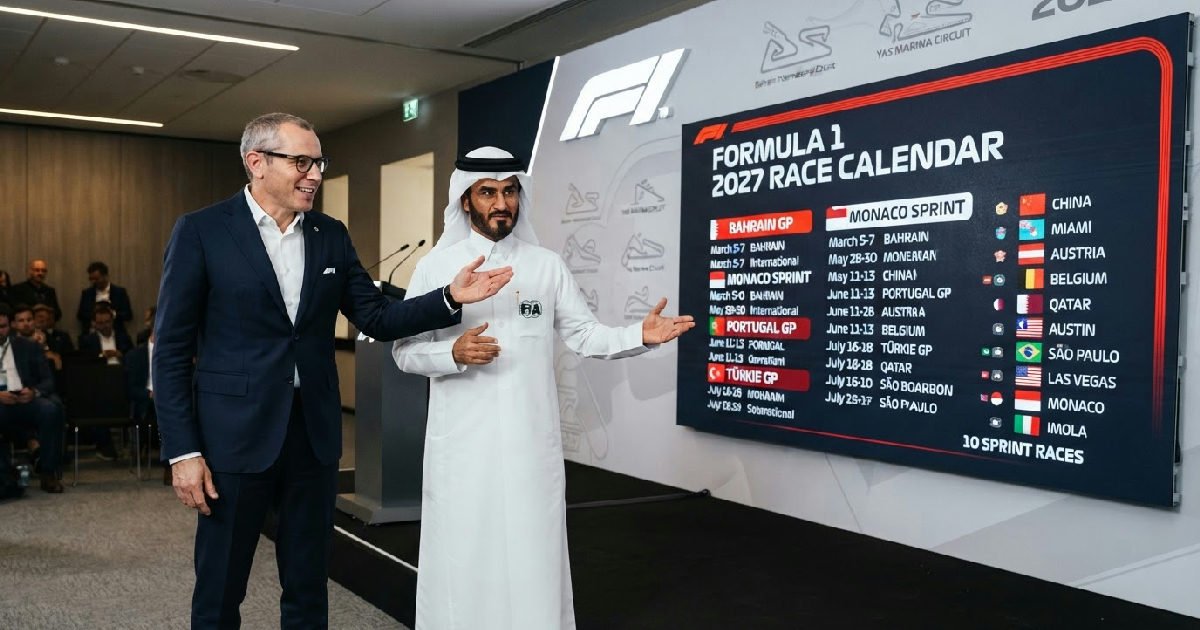
Formula 1 reveals 2027 F1 calendar with 10 Sprints
Formula 1 officially announced its 2027 FIA Formula One World Championship calendar on 2026-09-16, confirming a packed schedule of 24 Grands Prix. The expanded season will also see a significant increase to 10 Sprint events, a move that has sparked considerable debate among fans and pundits.
The announcement comes as F1 leadership, including CEO and President Stefano Domenicali and FIA President Mohammed Ben Sulayem, navigate a complex global landscape. Concerns persist regarding ongoing geopolitical tensions in the Middle East, which could yet impact the proposed early and late-season races in the region.
Details of the 2027 F1 calendar
The 2027 season is set to kick off on March 14, 2027, with the Bahrain Grand Prix at Sakhir, and will conclude on December 12, 2027, at the Abu Dhabi Grand Prix. Pre-season testing for the new campaign is scheduled for February 24-27, 2027, also in Bahrain.
The calendar, approved by the World Motor Sport Council, aims for geographical efficiency with races grouped together to enhance sustainability. Portugal, returning to Portimão, and Türkiye, back at Istanbul Park, will host races on June 20 and October 3, 2027, respectively, marking their first appearances since 2021.
Notably, the Barcelona Grand Prix is absent from the 2027 schedule, though it’s slated to return in 2028 as part of a rotation deal with the Belgian Grand Prix. The Dutch Grand Prix at Zandvoort was held for the final time in 2026, making way for new opportunities on the global racing stage.
Sprint Race Expansion Fuels Debate
The most significant shift for 2027 is the increase in Sprint events from six to ten. This move reflects F1’s push to offer more “intensity, drama, and wheel-to-wheel action” to fans, according to Stefano Domenicali.
New venues set to host sprints for the first time include Bahrain, Australia, Japan, Monaco, and Abu Dhabi. They join returning Sprint hosts such as Canada, Great Britain at Silverstone, Italy at Monza, Brazil in São Paulo, and Qatar at Lusail.
F1 management cites strong metrics supporting the sprint format, with total viewership on Sprint weekends reportedly 12% higher than non-Sprint weekends. Sprint Qualifying is also up to three times more popular than Free Practice sessions.
Monaco and Season Opener Draw Criticism
The inclusion of Monaco on the sprint schedule for the first time has particularly raised eyebrows. Many consider the tight street circuit ill-suited for sprint racing, given the historical difficulty in overtaking.
However, some pundits, like Jon Noble, suggest the format could introduce “jeopardy” by eliminating two practice sessions. This means drivers will have just one practice before qualifying for the sprint, potentially leading to more unpredictable outcomes on a track where qualifying is paramount.
Scott Mitchell-Malm, a prominent voice, lambasted the inclusion of a season-opening sprint race as “sacrilege.” He argued this move would burn the traditional excitement and build-up of the year’s first Grand Prix on a “shallow impersonation” of the main event. He feels even a great sprint race diminishes the fundamental joy of the season’s inaugural main event.
Geopolitical Tensions Cloud Middle East Races
Despite the official announcement, the stability of the Middle Eastern races remains a significant concern. Bahrain, Saudi Arabia, Qatar, and Abu Dhabi are all listed with an asterisk, indicating their status is not fully assured due to ongoing regional conflicts.
Reports suggest that some insurance companies are hesitant to approve coverage for races in these locations. This echoes the 2026 season, which saw both the Bahrain and Saudi Arabian Grands Prix postponed, with Malaysia stepping in as a replacement.
Formula 1 has prepared contingency plans, with sources indicating backup events are in the pipeline. Should the Middle East situation prevent the planned start, an alternative involves commencing the season in China, followed by Japan. Stefano Domenicali has reaffirmed F1’s commitment to a full 24-race calendar, irrespective of the geopolitical challenges.
The Sprint Format’s Identity Crisis
While the sprint expansion is a reality, its effectiveness continues to be questioned by some observers. Edd Straw argues that sprints currently lack a distinct identity, often appearing as merely “condensed, single-stint versions” of the main Grand Prix.
He contends that despite being more engaging than a Free Practice session, sprints haven’t fully leveraged their potential to become “must-see viewing.” Straw advocates for a less conservative approach, one that redefines the competitive challenge rather than just offering a shorter race.
He suggests F1 should explore innovative ways to make sprint qualifying and the race format more distinct. This would ensure sprints genuinely add to the sporting spectacle and test teams in novel ways.
Charting Formula 1’s Future Growth
The strategic decisions embedded in the 2027 calendar underscore Formula 1’s ambition for global growth. Mohammed Ben Sulayem highlighted the calendar as a “strong reflection of the global appeal” of the sport, emphasizing its blend of tradition, innovation, and fan engagement.
F1 CEO and President Stefano Domenicali highlighted the 2027 calendar’s blend of “iconic circuits and vibrant cities.” He expressed excitement about welcoming Portugal and Türkiye back, alongside the expanded Sprint program, which aims to provide “more intensity, drama, and wheel-to-wheel action.” Domenicali stated that Formula 1 continues its global growth.
FIA President Mohammed Ben Sulayem reinforced this sentiment, calling the 2027 calendar “a strong reflection of the global appeal and continued growth of our sport.” He noted the 24 Grands Prix across five continents, emphasizing the mix of tradition and innovation. The expanded Sprint program further enhances fan engagement while maintaining high sporting standards.
Ultimately, the 2027 calendar presents a bold vision for Formula 1, albeit one tempered by practical considerations and ongoing debates about the best way to evolve the sport. The coming season will be a critical test of how these changes resonate with the core fanbase and new spectators alike.